04.12.2025
GEODIS Pilots Southeast Asia’s First Cross-Border Trucking Service Using Renewable Diesel
GEODIS, a global leader in transport and logistics, has announced the launch of the region’s first cross-border trucking operation to be powered by Neste MY Renewable Diesel™, marking a major milestone in the decarbonization of its regional road network.
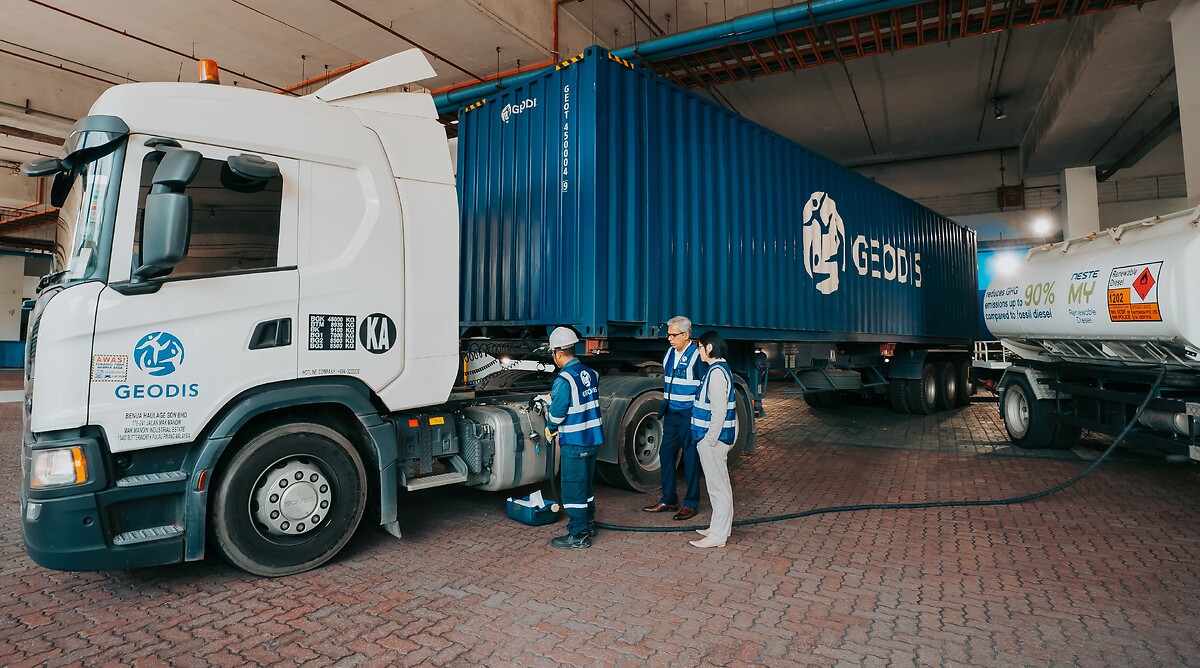
The pilot features a dedicated Euro-5 truck travelling from Singapore to the Thailand-Malaysia border using renewable diesel supplied by Neste, the world's leading producer of sustainable aviation fuel (SAF) and renewable diesel. Interion, a Singapore-based fuel solutions provider, will enable the fuel distribution and delivery for the pilot operations.
Renewable diesel, also known as hydrotreated vegetable oil (HVO), is produced from 100% renewable raw materials such as used cooking oil and animal fat waste. The use of Neste’s renewable diesel, enables up to 90% reduction in greenhouse gas (GHG) emissions compared to using conventional diesel across the lifecycle of the fuel. A drop-in fuel, renewable diesel can be used in existing diesel engines without any modification and offers an immediate and scalable pathway for lowering transport GHG emissions across operational fleets.
Conducted in collaboration with Neste and Interion, the pilot will evaluate real-world fuel performance, cross-border operational feasibility, supply chain reliability, and carbon-reduction outcomes. Insights gained will help shape GEODIS’ wider adoption plans for renewable fuels across the Asia Pacific region.
“We are proud to embark on the first-ever ASEAN cross-border decarbonization trucking pilot powered by renewable diesel. Transitioning to renewable fuels is a critical part of our mission to build a more sustainable supply chain for our customers and communities,” said Esther Cheong, Regional Sustainability Director, GEODIS Asia Pacific and Middle East. “Together with our partners Neste and Interion, we are demonstrating the practical benefits of renewable fuels and setting the groundwork for broader adoption across the region.”
“We are pleased to support GEODIS with our Neste MY Renewable Diesel, enabling immediate and meaningful GHG emissions reductions,” said Mario Mifsud, Vice President, Renewable Fuels Sales & Trading, EMEA & APAC, Neste. “Collaborations like this showcase how renewable fuels can lower the climate impact of road transportation in Southeast Asia.”
The initiative aligns with GEODIS’ broader strategy to reduce its emissions of greenhouse gases and atmospheric pollutants and managing its resources in a responsible manner. Following the pilot, GEODIS aims to build upon its decarbonization efforts for cross-border road operations and scale renewable fuel adoption across its fleet in the region.
The investment is also indicative of GEODIS’ SBTi approved commitment to addressing climate change. This strategy aligns with the 2015 Paris Agreement, seeking to limit global temperature rise to 1.5°C by the end of this century.