Low-Emission Zones (LEZs): What Impact Do They Have on Urban Transportation and Logistics?
In France, fine particulate matter in the air is responsible for nearly 40,000 deaths each year*. That is why the introduction of Low-Emission Zones (LEZs) has become necessary across the country.
These Low-Emission Zones (LEZs) have gradually transformed traffic patterns in major cities. For businesses, these new rules are also changing the way deliveries are made and logistics flows are organized. Here’s what you need to know about LEZs and their impact on urban transport and logistics.
What Is a Low-Emission Zone (LEZ)?
A Low-Emission Zone (LEZ) is a designated area established in certain cities to restrict the movement of the most polluting vehicles. This measure was introduced as part of the 2019 Mobility Framework Act and was later strengthened in 2021 by the Climate and Resilience Act. The aim of this policy is to improve air quality by reducing emissions from road traffic.
Broadly speaking, there are two types of LEZ:
- Low-Emission Zones (LEZs) established in cities where pollution thresholds are regularly exceeded: these areas are called “LEZ territories,” including, notably, the Greater Paris metropolitan area, Toulouse Metropolitan Area, Bordeaux Metropolitan Area, and the Lyon metropolitan area.
- LEZs established in all metropolitan areas with more than 150,000 residents: these zones are called “vigilance territories.”
As of January 1, 2025, LEZ requirements apply to metropolitan areas with more than 150,000 residents, depending on local implementation rules. As a result, certain Crit’Air 3, 4 and 5 vehicles, as well as unclassified vehicles, may be restricted from driving or parking within these areas.
The Crit’Air sticker for driving in a ZFE
The Crit’Air sticker classifies vehicles based on their pollution level and determines whether a vehicle is authorized to enter an LEZ. Within an LEZ, what matters is the vehicle’s pollution level. The Crit’Air sticker classifies vehicles on a scale from 0 to 5:
- Crit’Air 0: electric or hydrogen-powered vehicles
- Crit’Air 1 and 2: newer, less polluting vehicles
- Crit’Air 3, 4, and 5: older vehicles, subject to restrictions or ban
All commercial vehicles are also affected: utility vehicles, heavy-duty trucks, delivery vehicles, and corporate fleets. Of course, certain vehicles are exempt. These include emergency vehicles, medical vehicles, vehicles operated by public utilities, and public transportation.
Good to know : A ZFE pass can be requested in certain cities. These individual exemptions allow temporary access to ZFEs under certain conditions. Most cities offer this ZFE pass, such as the Strasbourg Eurometropolis, Greater Reims, and the Aix-Marseille Provence Metropolis.
A New Reality for Urban Logistics
Urban logistics—and in particular “last-mile” delivery—have been significantly impacted by the implementation of ZFEs. Delivery operations have had to be redesigned to adapt to the new regulations.
Today, a large proportion of the vehicles used for deliveries do not yet meet the new standards. As a result, certain areas are becoming difficult or even impossible for delivery vehicles to access. Routes sometimes need to be reworked, and delivery schedules may be restricted in certain areas. Fleets must also transition to cleaner vehicles.
Low-Emission Zones are thus pushing companies to adopt more sustainable and efficient models.
Freight transport must adapt
To continue delivering their goods, transportation providers must now rely on solutions that are more flexible, sustainable, and better suited to urban constraints. At GEODIS, this transformation is driven by several complementary strategies.
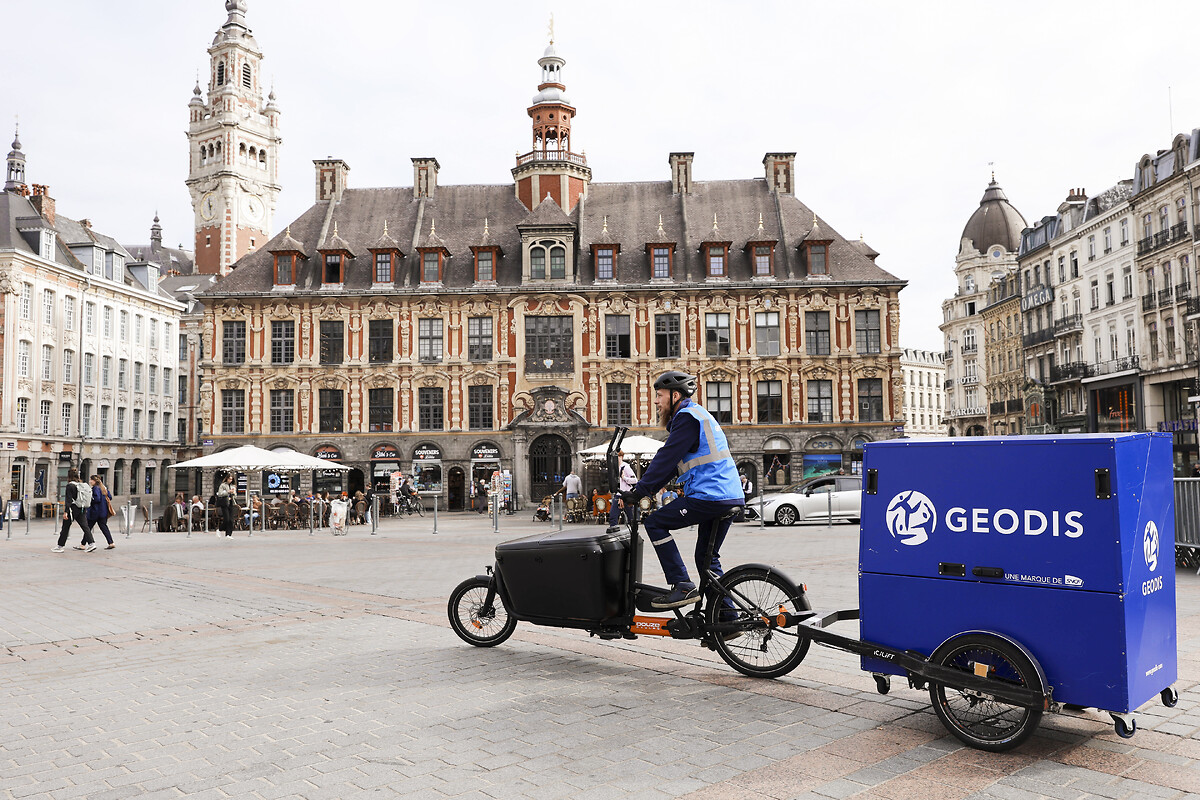
Road transport remains the backbone of logistics. It handles the majority of daily freight flows. But in LEZs, it is gradually shifting toward low-emission vehicles, such as electric trucks or those powered by alternative energy sources. Carriers are also ensuring they optimize their routes as much as possible to minimize the number of kilometers traveled. For single- and multi-package express deliveries, pallet transport is also adapting to LEZs. For the last mile in particular, sustainable modes of transport, such as cargo bikes or electric utility vehicles, are increasingly being used in city centers when appropriate.
In the face of these restrictions, a single solution is no longer sufficient. Multimodal transport has therefore become essential. It involves combining several modes of transport—such as road, rail, or maritime transport—to move goods as efficiently as possible. In practice, long distances can be covered by train or by sea, while the last few kilometers can be traveled by road using more sustainable modes of transportation. This approach helps reduce CO₂ emissions, particularly by limiting road traffic and the number of heavy-duty trucks traveling through urban centers.
Rail is also a mode of transport that plays a vital role in this transformation. Rail freight allows for the transport of large quantities of goods over long distances with a reduced carbon footprint. It is a particularly effective solution for relieving road congestion and limiting emissions. And for international deliveries, ocean freight also aligns with a more sustainable approach to freight transport.
As for air freight, it is used when delivery times are very short or for high-value goods. It remains essential in certain situations, even though it has a greater environmental impact. The challenge today is to better integrate this mode of transport with the others to limit its use to only when necessary.
Low-Emission Zones (LEZs): A Constraint, but Also an Opportunity
Low-Emission Zones (LEZs) may seem restrictive at first glance. They do indeed require rapid—and sometimes costly—changes, particularly for companies that need to replace their fleets. But this initiative also paves the way for more modern, cleaner, and smarter logistics.
By encouraging businesses to reevaluate their modes of transportation and the organization of their logistics flows, LEZs foster the emergence of more efficient logistics models. The development of low-emission vehicles (cargo bikes, electric vehicles, etc.), route optimization, and the use of multimodal transportation not only help meet regulatory requirements but also improve efficiency and reduce the environmental footprint of deliveries.
LEZs therefore do not merely represent constraints for the logistics sector. Rather, they help accelerate the adoption of logistics that are more agile, more sustainable, and better suited to the expectations of local communities, businesses, and customers. For logistics providers like GEODIS, the challenge is to transform these new regulatory requirements into drivers of innovation in order to offer increasingly efficient and sustainable transportation solutions.
*https://www.atmo-france.org/article/chiffres-cles