
06/26/2026

CBP Accepting Entries Flagged for Reconciliation in CAPE Effective June 29, 2026

Check out this week's Customs Corner to read about CBP Accepting Entries Flagged for Reconciliation in CAPE Effective June 29, 2026 and more.

Trade and Customs Updates

CBP Accepting Entries Flagged for Reconciliation in CAPE Effective June 29, 2026 


U.S. Customs and Border Protection announced that, beginning June 29, 2026, the Consolidated Administration and Processing of Entries (CAPE) system will begin accepting entries flagged for reconciliation (entry types 01, 02, and 06). This update maintains all previous requirements from Phase 1 and applies to unliquidated entries and those within 80 days of liquidation. 


Under the new process, once recon flagged entries are accepted through CAPE, the trade community may submit the reconciliation entry, with IEEPA duties being removed from flagged entries prior to reconciliation filing.  


Entries with a reconciliation entry on file (entry type 09) are excluded from the June 29 deployment and will be addressed in a future CAPE phase. Importers are reminded to file reconciliation entries promptly if deadlines are approaching, as the CAPE process does not prevent the reconciliation of eligible entries. For additional information, refer to CSMS #68340863. 


Reference: 

CSMS # 69035485 - UPDATE – Consolidated Administration and Processing of Entries (CAPE) for IEEPA Refunds - Entries Flagged for Reconciliation 

CBP Issues Withhold Release Orders on Jordanian Garment Factories Over Forced Labor Concerns 

U.S. Customs and Border Protection announced on June 23, 2026, the issuance of two Withhold Release Orders (WROs) targeting garments produced by Needle Craft Ltd. and Casual Wear Apparel L.L.C., both garment-manufacturing factories in Jordan. Effective immediately, CBP officers at all U.S. ports of entry will detain shipments of garments from these companies following an investigation that uncovered credible evidence of forced labor in their production processes. 


The WROs were issued under 19 U.S.C. § 1307, which prohibits the import of goods made with forced labor. CBP’s investigation included analysis of media reports, official Jordanian documents, company records, victim and NGO statements, and other evidence, demonstrating that workers at both factories were subjected to several International Labour Organization indicators of forced labor, including withheld wages, excessive overtime, intimidation, and abusive conditions. 


Executive Assistant Commissioner of the Office of Trade, Susan S. Thomas, emphasized that these are the fifth and sixth WROs issued by CBP this fiscal year, reinforcing the agency’s commitment to eliminating exploitative labor from U.S. supply chains. Importers whose shipments are detained under these WROs may choose to destroy or export the goods, or demonstrate that their products were not made with forced labor. 


With these latest actions, CBP is now enforcing 58 active WROs and eight Findings under the forced labor law, further strengthening efforts to protect the integrity of U.S. commerce and promote ethical trade practices. 


Reference: 

CSMS # 69031301 - Withhold Release Orders (WROs) on Garments Produced in Jordan by Needle Craft Ltd. and Casual Wear Apparel L.L.C. 

484(f) Committee Changes to the HTS- Proposed List Available, Official List Still Pending 

As of late June 2026, the official list of approved 484(f) Committee changes for the upcoming July 1, 2026 updates has not yet been published by the ⁠U.S. International Trade Commission (USITC)


While the committee has drafted a preliminary list of changes affecting certain 10-digit Harmonized Tariff Schedule (HTS) statistical reporting numbers, these numbers remain tentative and subject to revision until officially finalized. List of proposed changes 


Key Timelines to Expect 


  • Standard Rollout Timing: The finalized 484(f) Committee changes are historically uploaded to the USITC website within the final days of June or directly on July 1.  

  • System Implementation: Once approved, U.S. Customs and Border Protection (CBP) will deploy the new numbers through a Harmonized System Update (HSU) in the Automated Commercial Environment (ACE) 

CBP Announces Deactivation of Unused Importer Numbers, Outlines Reactivation Process

In line with the “Strengthening Customs Enforcement” Executive Order, U.S. Customs and Border Protection has begun deactivating Importer of Record numbers in the Automated Commercial Environment (ACE) that have been inactive for over a year and have no outstanding post-entry transactions.


CBP reminds importers and the trade community that reactivation of a deactivated IOR number should be done through ACE, in collaboration with a customs broker, to prevent processing delays. To reactivate an inactive IOR, a broker using the Automated Broker Interface (ABI) must send a Transaction Processing (TP) message with Action Code “A” to update the status from “20-Inactive” to “10-Active,” including all required data from CBP Form 5106. 


If ABI reactivation is not possible, importers may submit an updated CBP Form 5106 with all required information to their Center Entry Specialist Team via email, including “IOR reactivation request” in the subject line and an explanation in the message body. The IOR will be reactivated based on the Center’s current workload. 


CBP urges importers to first check the status of their IOR in the ACE Portal Account before seeking assistance. 


Reference: 

CSMS # 69056621 - Process to Re-Activate a Deactivated Importer of Record in ACE

United States and Australia Sign Customs Cooperation Agreement to Strengthen Security and Trade 

U.S. Customs and Border Protection announced the signing of a Customs Mutual Assistance Agreement (CMAA) with Australia on June 25, 2026, in Brussels, Belgium. This bilateral agreement aims to boost cooperation between the two countries in preventing, detecting, and investigating customs-related crimes, supporting judicial processes, and enhancing legitimate trade and travel through more efficient enforcement. 


"By formalizing this partnership, we are laying the groundwork for more effective security cooperation with Australia," said CBP Commissioner Rodney S. Scott. "This agreement will help us safeguard our borders, uphold the integrity of international trade, and address emerging threats together." 


Once in force, the CMAA will enable the United States and Australia to exchange information and provide mutual assistance on customs offenses, strengthening their ability to combat issues such as terrorism, drug trafficking, and transnational crime. The agreement also establishes a legal framework for sharing evidence and supporting judicial proceedings, including cases involving duty evasion, trafficking, money laundering, and activities related to terrorism. 


CBP and U.S. Immigration and Customs Enforcement will serve as the primary U.S. agencies implementing the agreement, which underscores the United States’ ongoing commitment to working closely with Australia to secure borders and protect international trade. 


Reference: 

US, Australia sign Customs Mutual Assistance Agreement | U.S. Customs and Border Protection 

CBP Updates Validations for CAPE Declarations in ACE 

U.S. Customs and Border Protection has revised certain validation rules for entries submitted under Consolidated Administration and Processing of Entries (CAPE) Declarations in the Automated Commercial Environment (ACE), streamlining the entry process and addressing previous errors. 


Importers are now advised to resubmit entries that were previously rejected due to the following errors: 


  • GOODS VALUE AMOUNT MUST BE REPORTED ON THE CH 1-97: This validation has been removed, so entries that triggered this error will now be accepted. 
  • HTS RELATIONSHIP/SEQUENCE MISMATCH: This error has been split into two more precise messages and the validation narrowed, allowing previously blocked valid entries to be accepted or to receive one of the following new messages: 
  • INVALID HTS: Occurs when the line action date does not fall within the active dates for the Harmonized Tariff Schedule (HTS) codes. If the HTS code is expired, importers should file a Post-Summary Correction (PSC) to update the code before resubmitting the entry. 
  • HTS RELATIONSHIP MISMATCH: Occurs when a required corresponding HTS code for duty calculation is missing. Importers should file a PSC to add the correct code and then resubmit the entry. 


A complete list and descriptions of CAPE validation error messages is available at the International Emergency Economic Powers Act (IEEPA) Duty Refunds webpage and the CAPE Declarations and Error Definitions Quick Reference Guide.

CPSC Seeks Public Input on Flammability Standards for Clothing and Vinyl Plastic Film 

The U.S. Consumer Product Safety Commission (CPSC) is inviting public comments on its information collection requirements related to flammability standards for clothing textiles and vinyl plastic film, aimed at preventing dangerous products from entering the U.S. market. 


The Safety Standard for Flammability of Clothing Textiles (16 CFR part 1610) prohibits the sale of dangerously flammable clothing materials in the United States and sets out testing methods, classification criteria, and warning guidelines for textile flammability. Similarly, the Standard for the Flammability of Vinyl Plastic Film (16 CFR part 1611) establishes minimum safety requirements for nonrigid vinyl plastic film used in apparel, covering a range of materials and prescribing tests to ensure these products are not prone to rapid burning. 


Manufacturers and importers must maintain records of flammability testing and any received guaranties for at least three years, as specified under the Flammable Fabrics Act (FFA). They must also provide certification, such as a General Certificate of Conformity (GCC) for general-use products or a Children’s Product Certificate (CPC) for children’s apparel, confirming compliance with these standards based on CPSC-approved testing. Importers of treated textiles must keep proof of treatment and may be required to provide affidavits or performance bonds to U.S. Customs and Border Protection, though such shipments are rare. 


The Commission is specifically seeking feedback on the necessity, accuracy, and utility of these information collection requirements, as well as suggestions to reduce any related burden, including the adoption of electronic or automated processes. Interested parties are encouraged to submit written comments on these topics to help CPSC assess and potentially improve its data collection procedures. 


Reference: 

2026-12770.pdf 

NOAA Fisheries Lifts Seafood Import Restrictions on Suriname Following Favorable Comparability Findings

The National Marine Fisheries Service (NOAA Fisheries) announced on June 22, 2026, that it has issued positive comparability findings for Suriname's fisheries, resulting in the removal of seafood import restrictions from the country under the Marine Mammal Protection Act (MMPA) Import Provisions. 


Effective immediately, seafood imports from Suriname to the United States no longer require a Certification of Admissibility (COA). However, NOAA Fisheries notes that a COA may still be necessary if the seafood products are processed in a country that remains subject to MMPA-related import restrictions. 


For more details, see the official notice in the Federal Register: https://www.federalregister.gov/d/2026-12494. 


Reference: 

CSMS # 69054058 - National Marine Fisheries Service Lifts Marine Mammal Protection Act Import Restrictions for Suriname

CBP Announces Interim Final Rule Suspending De Minimis Exemption

U.S. Customs and Border Protection has announced an interim final rule (IFR) indefinitely suspending the de minimis exemption for international mail shipments and introducing a new postal informal entry process for certain goods entering the United States via mail. The rule takes effect on July 24, 2026, with a compliance deadline set for October 22, 2026. CBP is inviting public comments on the IFR, which must be submitted by July 24. 


Additionally, CBP issued a separate Federal Register notice that similarly suspends the de minimis exemption—allowing duty-free entry of low-value shipments—for merchandise arriving by all modes of transport other than international postal mail. This notice also has comment deadline of July 24. 

Reference: 


2026-12669.pdf 

2026-12670.pdf 

The New Rules of U.S. Importing: Navigating the June 3 Executive Order on CustomsEnforcement

On June 3, the White House issued the Executive Order on “Strengthening Customs Enforcement.” This directive initiates the most aggressive overhaul of U.S. import regulations in years. With tight implementation deadlines ranging from 45 to 180 days, the rules for importing into the U.S. have fundamentally changed.


This new directive significantly restricts foreign entities, eliminates penalty mitigation for repeat errors, and ties corporate compliance directly to your ability to secure customs bonds.


Join us alongside a Alan Klestadt Partner GDLSK and Mike Brown President/CEO from Avalon Risk Management for an essential live briefing. We will translate this executive order into immediate, actionable steps for your business.


Webinar Details:

  • Date: June 30, 2026
  • Time: 2:00 PM EST
  • Duration: 60 Minutes


Reference:

https://events.teams.microsoft.com/event/b3aae48b-b479-419a-989e-58303c805525@c460f1c1-553a-45e6-8d52-7e9ec9dccfec

U.S. Customs and Border Protection Announces Registration Open for June Trade Enforcement Webinars 

Details: U.S. Customs and Border Protection (CBP) is pleased to announce that registration is now open for its free quarterly webinars. These essential sessions are designed to empower the public with the knowledge to effectively report suspected trade violations and file Enforce and Protect Act (EAPA) allegations with CBP.  


Rescheduled August Webinar Dates: 

Please note that due to the recent government shutdown, the March and April webinars have been rescheduled. We encourage you to plan for these new dates:  


  • Rescheduled Trade Violations Reporting (TVR) Webinar: Monday, August 10, 2026, at 1:00 p.m. EST  
  • Rescheduled Enforce and Protect Act (EAPA) Webinar: Wednesday, August 12, 2026, at 1:00 p.m. EST  


Registration links for the August rescheduled webinars will become available one month prior to each webinar date at https://go.dhs.gov/4i4.  


Registration is free and open to everyone, but you must register to attend. 


Reference: 


CSMS # 68772822 - U.S. Customs and Border Protection Announces Registration Open for June Trade Enforcement Webinars

National Commodity Specialist Division (NCSD) June and July 2026 Webinars 

The National Commodity Specialist Division, part of the Office of Trade, is launching a new series of over 30 commodity-specific educational webinars aimed at supporting both internal and external stakeholders. This year’s program, themed "The Future of Trade: Innovation and Emerging Technology," will focus on the impact of rapidly advancing technology while also offering general classification guidance to facilitate legitimate trade. 


The webinars will run from May through September 2026, beginning at 1:30 p.m. ET and lasting approximately one hour, except for sessions on September 22, 24, and 25, which will start at 11:00 a.m. ET. Registration is currently open for the June webinars, with monthly registration for subsequent sessions through September. 


The webinars will be hosted on the WebEx platform to ensure a seamless experience, and recordings will be posted publicly at Trade Outreach Webinars | U.S. Customs and Border Protection 

Upcoming webinar links and further details are available on the CBP website Trade Outreach Webinars | U.S. Customs and Border Protection 


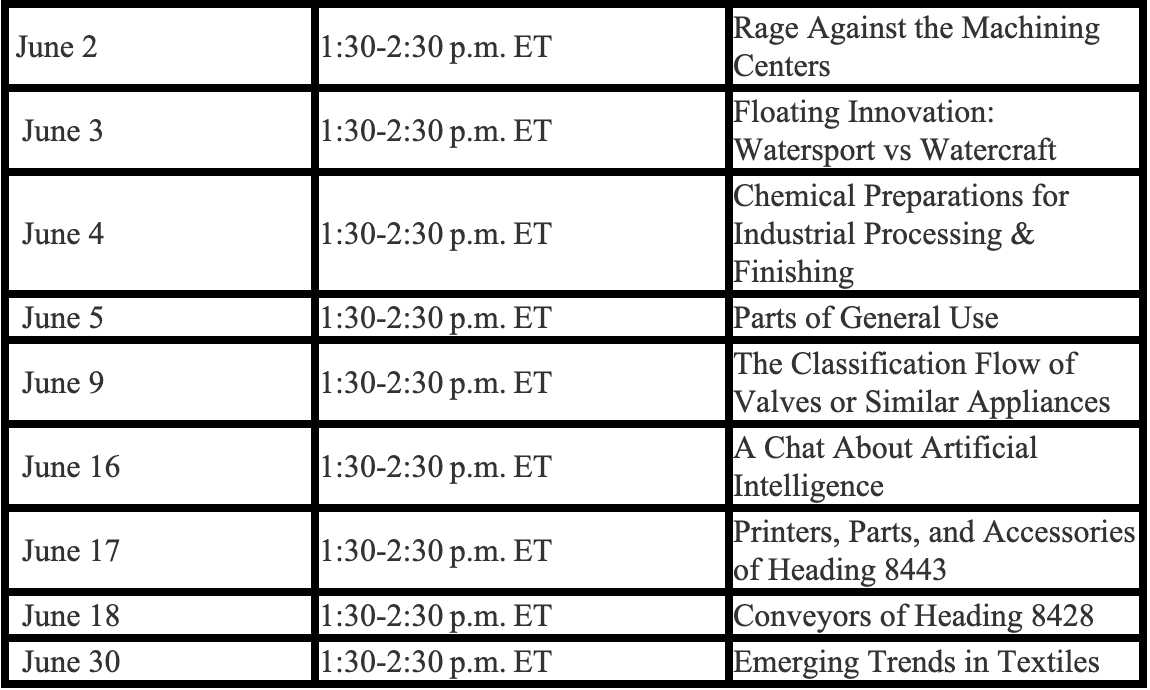
The June schedule is as follows:  
 

NCSD’s July Webinar Schedule: 


Wednesday, July 1, 2026 at 1:30 p.m. ET: Festivus for the Rest of Us! Festive Article Classification – The “Festivus for the Rest of Us! Festive Article Classification” is part of the 2026 Educations Commodity Specific Webinar Series hosted by the National Commodity Specialist Division, Regulations and Rulings, Office of Trade. This webinar highlights recent updates to Chapter 95 festive article classification and clarifies common classification questions. 


Thursday, July 2, 2026 at 1:30 p.m. ET: Stepping Forward in Smart Kicks – The “Stepping Forward in Smart Kicks” is part of the 2026 Educations Commodity Specific Webinar Series hosted by the National Commodity Specialist Division, Regulations and Rulings, Office of Trade. This webinar will explain the classification of smart footwear. 


Tuesday, July 7, 2026 at 1:30 p.m. ET: Plates, Sheets, Film, Foil & Strip of Plastics – The “Plates, Sheets, Film, Foil & Strip of Plastics” is part of the 2026 Educations Commodity Specific Webinar Series hosted by the National Commodity Specialist Division, Regulations and Rulings, Office of Trade. This webinar will focus on the nuances of classification of plates, sheets, film, foil, and strip of plastics in headings 3920 and 3921 of the Harmonized Tariff Schedule of the United States. It will examine the applicable legal notes and Explanatory Notes.  


Wednesday, July 8, 2026 at 1:30 p.m. ET: Reinforced, Laminated or Both? Safety Headgear of 6506 – The “Reinforced, Laminated or Both? Safety Headgear of 6506” is part of the 2026 Educations Commodity Specific Webinar Series hosted by the National Commodity Specialist Division, Regulations and Rulings, Office of Trade. The webinar will examine the tariff classification of safety headgear under heading 6506, HTSUS, with a focus on distinguishing between reinforced plastics, laminated plastics and products incorporating both. The presentation will also explore how advancements in material engineering, smart protective equipment, and emerging manufacturing technologies are shaping the future of trade and creating new classification challenges for next generation safety headgear. 


Tuesday, July 14, 2026 at 1:30 p.m. ET: Anode Active Materials – An Overview – The “Anode Active Materials - An Overview” is part of the 2026 Educations Commodity Specific Webinar Series hosted by the National Commodity Specialist Division, Regulations and Rulings, Office of Trade. This webinar will discuss materials that are used to coat the anodes of lithium-ion batteries and discuss some recent trade related developments concerning them. 


Thursday, July 16, 2026 at 1:30 p.m. ET: Beverage Drinking Vessels Confusion: Let’s Classify It! – The “Beverage Drinking Vessels Confusion: Let’s Classify it!” is part of the 2026 Educations Commodity Specific Webinar Series hosted by the National Commodity Specialist Division, Regulations and Rulings, Office of Trade. This webinar will focus on the correct classification of various drinking vessels that are classified in Harmonized Tariff Schedule of the United States headings 3924, 6912, 7323, 7615, and 9617. 


Friday, July 17, 2026 at 1:30 p.m. ET: Display Devices are Getting “Smarter!” – The “Display Devices are Getting “Smarter!”” is part of the 2026 Educations Commodity Specific Webinar Series hosted by the National Commodity Specialist Division, Regulations and Rulings, Office of Trade. This webinar will provide an overview of the future of trade and how it impacts the tariff classification of innovative and emerging technology in flat panel display modules, wearable displays, monitors, and televisions, including how AI is transforming the future of displays. It will also provide the key difference between displays classified in headings 8524 vs. 8528, HTSUS, and case studies of the latest display technologies classified in these headings. 


Tuesday, July 21, 2026 at 1:30 p.m. ET: You’ve Got to Pick a Pocket or Two – The “You’ve Got to Pick a Pocket or Two” is part of the 2026 Educations Commodity Specific Webinar Series hosted by the National Commodity Specialist Division, Regulations and Rulings, Office of Trade.  The webinar will cover: CBP’s definition of a pocket; a discussion of what is, and is not, a pocket; the location/placement of pockets on garments; and how these considerations can affect the proper classification of apparel. 


Reference: 

Webinar External Schedule May Final 2026.pdf 

CSMS # 68770785 - National Commodity Specialist Division (NCSD) June 2026 Webinars 


CSMS # 68856484 - National Commodity Specialist Division (NCSD) July 2026 Webinars 

Get expert advice on customs and foreign trade, direct from our comprehensive customs brokerage and trade services teams.