06/19/2026

CBP Issues Updated Guidance on Retroactive Duty Refunds and Renewed Preferences for AGOA and Haiti HOPE/HELP Programs and more!

Check out this week's Customs Corner to read about CBP Issues Updated Guidance on Retroactive Duty Refunds and Renewed Preferences for AGOA and Haiti HOPE/HELP Programs and more!

Trade and Customs Updates

CBP Issues Updated Guidance on Retroactive Duty Refunds and Renewed Preferences for AGOA and Haiti HOPE/HELP Programs

CBP has released revised instructions for importers seeking retroactive duty refunds under the African Growth and Opportunity Act (AGOA) and the Haiti HOPE/HELP trade preference programs. These updates follow the signing of H.R.7148 (“the Act”) by the President on February 3, 2026, which extends duty-free access for eligible imports from AGOA beneficiary countries and select Haitian products through December 31, 2026. 


The Act also revives special provisions for Haiti under the Caribbean Basin Economic Recovery Act and authorizes retroactive refunds of Column 1 ad valorem duties—excluding merchandise processing fees and other duty types—on eligible goods entered or withdrawn for consumption during the program lapse from October 1, 2025, to February 3, 2026. These refunds will be issued without interest. 


Importers were able to resume claiming AGOA preferential benefits for non-textile products as of February 6, 2026, by using the special program indicator SPI “D.” For AGOA and Haiti textile products, the applicable Harmonized Tariff Schedule (HTSUS) numbers, including qualifying chapter 98 designations, must be used when filing entries. Entries filed after February 3, 2026, are processed as current preferential claims, with standard procedures such as Post Summary Correction and Protest available for corrections or updates. 


Further, as of February 9, 2026, importers could again claim preferences on imports subject to the reestablished AGOA and Haiti quota programs. Entries made between February 4 and February 8, 2026, were processed once the quotas were reinstated. 

In addition, CBP announced that, pursuant to Presidential Proclamation 11030 issued on May 19, 2026, the Gabonese Republic (Gabon) has been reinstated as a beneficiary sub-Saharan African country under AGOA, retroactive to January 1, 2026. Non-textile imports from Gabon now qualify for preferential treatment under General Note 16 of the HTSUS, although Gabonese textile products remain ineligible for benefits. 


The instructions on how to file the refund request can be found in the CSMS. 

Reference: 


CSMS # 68987884 - CORRECTION: Reauthorization of Preferential Trade Legislative (PTL) Programs - African Growth and Opportunity Act (AGOA), Haiti Hemispheric Opportunity through Partnership Encouragement Act (HOPE), and Haiti Economic Lift Program (HELP) 

CBP Tightens Drawback Bond Validation: Key Error Codes Now Trigger Fatal Rejections

CBP has implemented critical updates to its Drawback bond validation process, effective June 16, 2026. The changes upgrade several error codes from “Informational” to “Fatal,” meaning that if any of these errors occur, the claim will be rejected and Accelerated Payment (AP) will be removed. 


The error codes now classified as Fatal are: 
003 (Invalid or Inactive Surety Code), 
004 (Inactive or Terminated Bond), 
008 (Not Authorized Accelerated Payment), 
082 (Invalid Bond Number), 
124 (Bond Detail Not Allowed – Bond Waived), 
125 (Not Eligible to Waive Bond), 
285 (Invalid Bond Type Status), 
286 (Invalid Bond Designation), 
287 (Bond Insufficient), 
144 (AP Not Allowed – Pending Ruling or Pending CID), 
566 (Bond Not in Effective Period), and 
589 (Surety Code Mismatch for Drawback Bond). 


CBP reminds filers that an Accelerated Payment request will be removed from any claim generating a Fatal error. The agency encourages all parties to review their bond information and ensure compliance to avoid processing delays or claim denials. 

Reference: 

CSMS # 68974644 - Updates to Drawback Bond Validations and Error Codes 

CBP Launches New Tools and Automation to Simplify ACE Portal Account Management 

U.S. Customs and Border Protection (CBP) has rolled out new tools and automation designed to streamline account management within the Automated Commercial Environment Secure Data Portal (ACE Portal). Among the enhancements, Trade Account Owner (TAO) accounts can now be automatically reactivated when a request is submitted from a TAO-associated email address, simply by emailing [email protected] with “reactivation” in the subject line. Confirmation or further instructions will be sent automatically. 


CBP reminds users that only TAOs can reactivate non-TAO accounts within their company, as detailed in CSMS # 68510928. For help identifying a company’s TAO, users can email [email protected]  with “Trade Account Owner Lookup” in the subject line; CBP's automation will notify the current TAO and confirm the lookup to the requester.


Additionally, CBP has introduced new webforms and automation for ACE Portal account applications and management. These webforms support scenarios such as applying for importer accounts (single or multiple Importer of Record numbers), adding sub-accounts or identifiers to existing accounts, and updating TAO information, making account management more efficient for trade participants. 


Reference: 

CSMS # 68966469 - ACE Portal: New Tools and Automation for Account Management 

CBP Issues Withhold Release Order on Serbian Copper Products Over Forced Labor Concerns 

U.S. Customs and Border Protection (CBP) has issued a Withhold Release Order (WRO) against copper and copper products manufactured by Serbia Zijin Copper D.O.O. (Serbia Zijin) in Serbia, effective immediately. CBP officers at all U.S. ports of entry will detain shipments from Serbia Zijin due to evidence of forced labor in production, marking the fourth WRO issued in Fiscal Year 2026 under 19 U.S.C. § 1307, which prohibits the import of goods made with forced labor. 


The WRO follows a CBP investigation that uncovered six International Labour Organization indicators of forced labor at Serbia Zijin, including abuse of vulnerability, wage withholding, intimidation, restricted movement, retention of identity documents, and excessive overtime. Supporting evidence included worker testimonies, photos, focus group notes, text messages, NGO reports, news media, and academic research. 


“U.S. manufacturers face unfair competition when foreign companies cut costs by using forced labor,” said CBP Office of Trade Executive Assistant Commissioner Susan S. Thomas, emphasizing CBP’s commitment to protecting human rights and economic security. 


Importers whose shipments are detained may destroy, export, or prove their goods were not produced with forced labor. With this action, CBP now enforces 56 WROs and eight Findings under forced labor laws, demonstrating its ongoing efforts to combat human rights abuses in global supply chains. 


Reference: 

CSMS # 68963141 - Withhold Release Order (WRO) on Copper and Copper Products Manufactured in Serbia, by Serbia Zijin Copper D.O.O. 

CBP Releases Updated Forced Labor Enforcement Guidance for Importers

U.S. Customs and Border Protection has announced the release of its newly updated Forced Labor Enforcement Operational Guidance for Importers, offering an overview of the three main authorities used to prevent the importation of goods produced with forced labor into the United States: 19 U.S.C. § 1307, the Uyghur Forced Labor Prevention Act (UFLPA), and the Countering America’s Adversaries Through Sanctions Act (CAATSA). 


The updated guidance features enhanced transparency for importers by consolidating information on enforcement processes—including UFLPA, Withhold Release Orders (WROs), Findings, and CAATSA actions—into a single document. It introduces new process maps and dedicated sections that provide step-by-step instructions on how importers should respond to detentions or exclusions under WRO, Finding, and CAATSA procedures. 


Additionally, the document includes appendices with recommended supply chain documentation for high-priority sectors, practical examples of UFLPA due diligence, and sample notices regarding detentions, exclusions, redelivery, and certificates of origin. 

CBP encourages all importers to review the updated guidance and carry out thorough due diligence of their supply chains before importing goods into the United States, reinforcing CBP’s commitment to combating forced labor and promoting ethical trade practices. 


The Forced Labor Enforcement Operational Guidance for Importers is available at https://www.cbp.gov/document/guides/cbp-forced-labor-enforcement-operational-guidance-importers. 


Reference: 


CSMS # 68927213 - Launch of CBP’s Forced Labor Enforcement Operational Guidance for Importers 

U.S. Customs and Border Protection Announces Registration Open for June Trade Enforcement Webinars 

U.S. Customs and Border Protection (CBP) is pleased to announce that registration is now open for its free quarterly webinars in June 2026. These essential sessions are designed to empower the public with the knowledge to effectively report suspected trade violations and file Enforce and Protect Act (EAPA) allegations with CBP.  


Upcoming June Webinar Dates (Registration Now Open): 

Please click on the direct links below to register for individual webinars:  


Rescheduled August Webinar Dates: 

Please note that due to the recent government shutdown, the March and April webinars have been rescheduled. We encourage you to plan for these new dates:  


  • Rescheduled Trade Violations Reporting (TVR) Webinar: Monday, August 10, 2026, at 1:00 p.m. EST 
  • Rescheduled Enforce and Protect Act (EAPA) Webinar: Wednesday, August 12, 2026, at 1:00 p.m. EST  


Registration links for the August rescheduled webinars will become available one month prior to each webinar date at https://go.dhs.gov/4i4.  


Registration is free and open to everyone, but you must register to attend. 


Reference: 

CSMS # 68772822 - U.S. Customs and Border Protection Announces Registration Open for June Trade Enforcement Webinars

National Commodity Specialist Division (NCSD) June and July 2026 Webinars 

The National Commodity Specialist Division, part of the Office of Trade, is launching a new series of over 30 commodity-specific educational webinars aimed at supporting both internal and external stakeholders. This year’s program, themed "The Future of Trade: Innovation and Emerging Technology," will focus on the impact of rapidly advancing technology while also offering general classification guidance to facilitate legitimate trade. 


The webinars will run from May through September 2026, beginning at 1:30 p.m. ET and lasting approximately one hour, except for sessions on September 22, 24, and 25, which will start at 11:00 a.m. ET. Registration is currently open for the June webinars, with monthly registration for subsequent sessions through September.


The webinars will be hosted on the WebEx platform to ensure a seamless experience, and recordings will be posted publicly at Trade Outreach Webinars | U.S. Customs and Border Protection 


Upcoming webinar links and further details are available on the CBP website Trade Outreach Webinars | U.S. Customs and Border Protection 


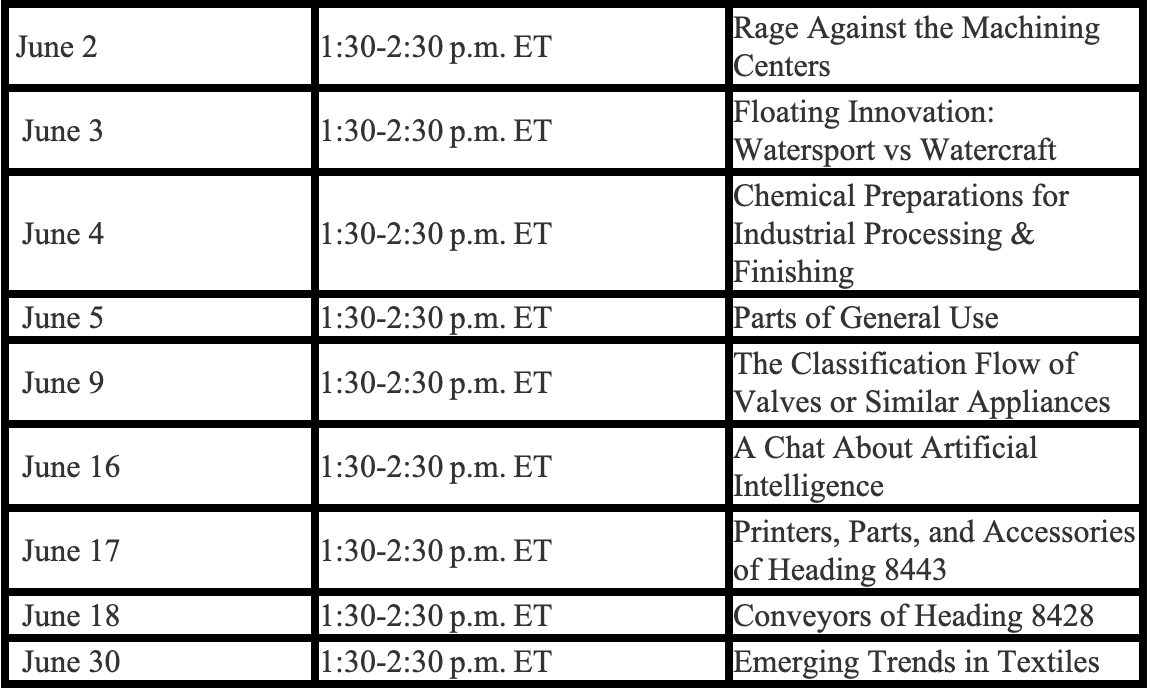
The June schedule is as follows:  


NCSD’s July Webinar Schedule: 

Wednesday, July 1, 2026 at 1:30 p.m. ET: Festivus for the Rest of Us! Festive Article Classification – The “Festivus for the Rest of Us! Festive Article Classification” is part of the 2026 Educations Commodity Specific Webinar Series hosted by the National Commodity Specialist Division, Regulations and Rulings, Office of Trade. This webinar highlights recent updates to Chapter 95 festive article classification and clarifies common classification questions. 

Thursday, July 2, 2026 at 1:30 p.m. ET: Stepping Forward in Smart Kicks – The “Stepping Forward in Smart Kicks” is part of the 2026 Educations Commodity Specific Webinar Series hosted by the National Commodity Specialist Division, Regulations and Rulings, Office of Trade. This webinar will explain the classification of smart footwear. 

Tuesday, July 7, 2026 at 1:30 p.m. ET: Plates, Sheets, Film, Foil & Strip of Plastics – The “Plates, Sheets, Film, Foil & Strip of Plastics” is part of the 2026 Educations Commodity Specific Webinar Series hosted by the National Commodity Specialist Division, Regulations and Rulings, Office of Trade. This webinar will focus on the nuances of classification of plates, sheets, film, foil, and strip of plastics in headings 3920 and 3921 of the Harmonized Tariff Schedule of the United States. It will examine the applicable legal notes and Explanatory Notes.  

Wednesday, July 8, 2026 at 1:30 p.m. ET: Reinforced, Laminated or Both? Safety Headgear of 6506 – The “Reinforced, Laminated or Both? Safety Headgear of 6506” is part of the 2026 Educations Commodity Specific Webinar Series hosted by the National Commodity Specialist Division, Regulations and Rulings, Office of Trade. The webinar will examine the tariff classification of safety headgear under heading 6506, HTSUS, with a focus on distinguishing between reinforced plastics, laminated plastics and products incorporating both. The presentation will also explore how advancements in material engineering, smart protective equipment, and emerging manufacturing technologies are shaping the future of trade and creating new classification challenges for next generation safety headgear. 

Tuesday, July 14, 2026 at 1:30 p.m. ET: Anode Active Materials – An Overview – The “Anode Active Materials - An Overview” is part of the 2026 Educations Commodity Specific Webinar Series hosted by the National Commodity Specialist Division, Regulations and Rulings, Office of Trade. This webinar will discuss materials that are used to coat the anodes of lithium-ion batteries and discuss some recent trade related developments concerning them. 

Thursday, July 16, 2026 at 1:30 p.m. ET: Beverage Drinking Vessels Confusion: Let’s Classify It! – The “Beverage Drinking Vessels Confusion: Let’s Classify it!” is part of the 2026 Educations Commodity Specific Webinar Series hosted by the National Commodity Specialist Division, Regulations and Rulings, Office of Trade. This webinar will focus on the correct classification of various drinking vessels that are classified in Harmonized Tariff Schedule of the United States headings 3924, 6912, 7323, 7615, and 9617. 

Friday, July 17, 2026 at 1:30 p.m. ET: Display Devices are Getting “Smarter!” – The “Display Devices are Getting “Smarter!”” is part of the 2026 Educations Commodity Specific Webinar Series hosted by the National Commodity Specialist Division, Regulations and Rulings, Office of Trade. This webinar will provide an overview of the future of trade and how it impacts the tariff classification of innovative and emerging technology in flat panel display modules, wearable displays, monitors, and televisions, including how AI is transforming the future of displays. It will also provide the key difference between displays classified in headings 8524 vs. 8528, HTSUS, and case studies of the latest display technologies classified in these headings. 

Tuesday, July 21, 2026 at 1:30 p.m. ET: You’ve Got to Pick a Pocket or Two – The “You’ve Got to Pick a Pocket or Two” is part of the 2026 Educations Commodity Specific Webinar Series hosted by the National Commodity Specialist Division, Regulations and Rulings, Office of Trade.  The webinar will cover: CBP’s definition of a pocket; a discussion of what is, and is not, a pocket; the location/placement of pockets on garments; and how these considerations can affect the proper classification of apparel. 

Reference: 

Webinar External Schedule May Final 2026.pdf 

CSMS # 68770785 - National Commodity Specialist Division (NCSD) June 2026 Webinars 


CSMS # 68856484 - National Commodity Specialist Division (NCSD) July 2026 Webinars 

The New Rules of U.S. Importing: Navigating the June 3 Executive Order on Customs Enforcement

On June 3, the White House issued the Executive Order on “Strengthening Customs Enforcement.” This directive initiates the most aggressive overhaul of U.S. import regulations in years. With tight implementation deadlines ranging from 45 to 180 days, the rules for importing into the U.S. have fundamentally changed.


This new directive significantly restricts foreign entities, eliminates penalty mitigation for repeat errors, and ties corporate compliance directly to your ability to secure customs bonds.

Join us alongside a Alan Klestadt Partner GDLSK and Mike Brown President/CEO from Avalon Risk Management for an essential live briefing. We will translate this executive order into immediate, actionable steps for your business.


Webinar Details:

  • Date: June 30, 2026
  • Time: 2:00 PM EST
  • Duration: 60 Minutes


Reference:

https://events.teams.microsoft.com/event/b3aae48b-b479-419a-989e-58303c805525@c460f1c1-553a-45e6-8d52-7e9ec9dccfec

Get expert advice on customs and foreign trade, direct from our comprehensive customs brokerage and trade services teams.