
06/12/2026
Geodis U.S. Trade & Customs Update
Check out this week's Customs Corner to read about the Geodis U.S. Trade & Customs Update, NOAA Fisheries Updates Trade Monitoring Requirements with New HTS Codes Effective July 1, 2026, and more.
Trade and Customs Updates
Geodis U.S. Trade & Customs Update
Section 122 Emergency Tariffs
The U.S. Court of International Trade recently ruled that the temporary 10% global Section 122 tariffs were unlawful. While a temporary stay currently allows U.S. Customs and Border Protection (CBP) to continue collecting these duties, Section 122 tariffs are statutorily limited to 150 days and are scheduled to expire on July 24, 2026, unless Congress takes further action.
IEEPA Refund Process
Following recent court decisions invalidating certain tariffs imposed under the International Emergency Economic Powers Act (IEEPA), the federal government is working through a potential refund process involving approximately 53 million import entries and an estimated $166 billion in duties.
Current milestones:
- June 2, 2026: The government formally appealed the court's universal refund directive, arguing that refunds should not automatically extend to importers who were not parties to the underlying litigation.
- June 29, 2026: CBP's reconciliation phase is expected to be completed.
- Late July 2026: Processing of finally liquidated entries is expected to begin.
- Refund eligibility for finally liquidated entries remains uncertain. The Department of Justice has argued that certain importers may need to pursue individual claims before the Court of International Trade to obtain refunds. As a result, the timing and scope of refunds remain subject to ongoing litigation.
ACH Requirements for Refunds
CBP now issues refunds exclusively through electronic payment. Importers should verify that:
- ACE Portal access is active
- ACH refund information is current.
- CBP Form 5106 information is accurate and up to date.
- U.S. banking information is properly configured to receive electronic refunds.
Failure to maintain current account information may delay refund processing.
Section 232: Metals & Pharmaceutical Actions
Metals Tariff Changes: Several significant adjustments have been made to Section 232 tariff administration:
- Tariffs on covered steel, aluminum, and copper products are now assessed against the full customs value of imported articles rather than solely the value or weight of the metal content.
- Duty rates are tiered based on foreign versus U.S. content.
- Derivative products containing less than 15% metal by weight are exempt from Section 232 duties.
- Certain agricultural equipment, HVAC systems, and mobile industrial machinery have received reduced tariff treatment.
- Additional steel and aluminum derivative products, including certain storage racks and lithographic plates, have been added to coverage.
Pharmaceutical Tariff Program: A new tariff framework targeting patented pharmaceuticals and active pharmaceutical ingredients (APIs) is being phased in.
Key dates:
- June 12, 2026: Deadline to submit company-specific onshoring applications to the Bureau of Industry and Security (BIS) to qualify for a reduced tariff rate.
- July 31, 2026: A 100% tariff is scheduled to apply to companies specifically identified in Annex III.
- September 29, 2026: The tariff expands to other importers of covered patented pharmaceutical products.
Standard generic drugs and biosimilars remain exempt under the current framework.
Reduced rates may be available for imports originating from certain trade-partner countries, including the United Kingdom, European Union, Japan, South Korea, Switzerland, and Liechtenstein.
Section 301: Forced Labor Enforcement Actions
The U.S. Trade Representative (USTR) has proposed a new framework targeting countries with alleged deficiencies in forced labor enforcement.
Proposed Forced Labor Duties
USTR has categorized approximately 60 economies based on the effectiveness of their forced labor prevention and enforcement programs.
Proposed measures:
- 10% additional duties on imports from countries determined to have formal forced labor prohibitions but inadequate enforcement.
- Canada, Ecuador, the European Union, Indonesia, Mexico, and Pakistan officially maintain domestic import prohibitions on forced labor goods but have failed to enforce them effectively.
- 12.5% additional duties on imports from countries determined to lack effective forced labor enforcement frameworks.
- The remaining 54 trading partners—including major manufacturing nations like China, Japan, India, the United Kingdom, Brazil, South Korea, and Vietnam—have neither imposed nor enforced any meaningful forced labor import bans.
Proposed exemptions:
USTR has proposed exemptions for certain critical supply-chain products as well as a limited apparel relief mechanism designed to mitigate the impact of the proposed duties.
Key dates:
- June 22, 2026: Requests to appear at public hearings are due.
- July 6, 2026: Written comments are due.
- July 7, 2026: Public hearings begin.
Importers with sourcing exposure in affected countries should evaluate potential duty increases now and consider participating in the comment process where appropriate.
Section 301: Excess Capacity Investigation
USTR's Section 301 investigation into structural excess capacity and production in manufacturing sectors has moved beyond the public comment and hearing phase and is currently under review.
The investigation covers 16 economies, including China, the European Union, Japan, South Korea, Mexico, Vietnam, India, and several Southeast Asian manufacturing hubs.
While no trade measures have been announced, USTR is evaluating whether foreign government policies and industrial support programs are creating unfair competitive advantages that burden U.S. commerce.
The investigation could ultimately result in additional Section 301 tariffs or other trade remedies later this year.
Importers should monitor developments closely, particularly if they source manufactured products from countries covered by the investigation.
Section 301: New Country-Specific Investigations
In addition to the above noted investigations, USTR has launched several country-specific Section 301 investigations that may result in additional tariffs or trade restrictions.
Brazil Investigation
USTR is continuing its investigation into Brazil's digital trade, intellectual property, and market access practices.
As part of that process, USTR has proposed a 25% tariff action on covered imports from Brazil.
Key dates:
- July 1, 2026: Public comment deadline.
- July 15, 2026: Statutory deadline for final action.
Vietnam Investigation
On May 29, 2026, USTR initiated a new Section 301 investigation focused on intellectual property rights and enforcement concerns in Vietnam.
Key Date:
- July 2, 2026: Deadline for public written comments.
Given Vietnam's growing role in global sourcing strategies, importers should closely monitor this investigation for potential future tariff actions or compliance requirements.
Executive Order on Customs Enforcement
A June 3 Executive Order introduces significant changes to customs enforcement priorities and importer accountability.
Key Dates:
- July 18, 2026 (45-Day Recommendations Mandate): The Secretary of Homeland Security (DHS), in consultation with the Office of Management and Budget (OMB), must submit formal legislative recommendations to the President to permanently strengthen customs enforcement and close existing Importer of Record (IOR) accountability gaps.
- September 1, 2026 (90-Day Mandate): DHS must implement streamlined tracking, rapid seizure, voluntary cargo abandonment, and expedited forfeiture processes for noncompliant shipments.
- November 30, 2026 (180-Day Mandate): CBP must launch new IOR eligibility rules, registry cleanups, risk-tiering frameworks, and minimum tangible U.S. asset/bonding mandates.
- June 2027 (1-Year Mark): DHS will submit an official report to the President reviewing the overall effectiveness and economic impact of these enforcement changes.
Importer of Record (IOR) Restrictions
- CBP will remove IORs who are inactive and verify remaining/active IORs for compliance.
- CBP will assign risk tiers based on an IORs compliance history and audit results.
- Foreign importers will face increased scrutiny and limitations regarding:
- Use of informal entry procedures.
- Eligibility for standard continuous customs bonds.
- Demonstration of sufficient U.S.-based assets or financial security.
Good Standing Requirements
CBP is expected to expand enforcement against importers with unresolved compliance deficiencies, potentially restricting import privileges and broker access for repeat offenders.
Enhanced Supply Chain Data Requirements
Importers must proactively provide expanded data disclosures to CBP.
- Required data points: Projected import volumes, beneficial ownership, and business affiliations.
- Required documentation: Foreign tax details, domestic asset records, and factory-level traceability.
Importers should anticipate expanded requests for:
- Factory-level identification data.
- Product traceability information.
- Material composition details.
- Production and sourcing records.
Increased Liability Exposure
The Executive Order accelerates collection actions against customs bonds and collateral while increasing compliance expectations for customs brokers conducting client due diligence.
- Repeat compliance offenders will receive zero penalty mitigation from CBP.
- Minimum financial penalties and liquidated damages for bond breaches will sharply increase.
- Customs brokers face maximum statutory penalties for failing to vet clients or delaying CBP responses.
What Importers Should Be Doing Now
With CBP shifting toward more aggressive enforcement and supply-chain verification, importers should begin preparing immediately.
Review Importer of Record Structures
- Confirm that your Importer of Record structure remains compliant, particularly if your organization relies on foreign entities, related-party importers, or nonresident importer arrangements.
Evaluate Bond Sufficiency
- Review continuous bond levels against current and projected duty exposure, especially if your products are subject to Section 232, Section 301, or other special tariff programs.
Strengthening Supply Chain Documentation
- Ensure your organization can quickly produce:
- Factory and manufacturer identification data.
- Country-of-origin records.
- Bills of materials.
- Material composition documentation.
- Supplier certifications and traceability records.
- Importers unable to substantiate sourcing claims should expect increased compliance risk.
We are here to support. Please contact us at [email protected] for additional assistance or feedback on any of the above topics.
NOAA Fisheries Updates Trade Monitoring Requirements with New HTS Codes Effective July 1, 2026
The U.S. National Marine Fisheries Service (NOAA Fisheries) has announced several HTS codes flagged for permit and reporting requirements under various NOAA Fisheries trade monitoring programs are being expanded to include additional codes.
The updated regulations apply to three key programs: the Antarctic Marine Living Resources Program (AMLR), the Seafood Import Monitoring Program (SIM), and the Tuna Tracking and Verification Program (370).
Beginning July 1, 2026, CBP will start flagging the newly added or revised HTS codes. This means importers using these codes must comply with all associated permitting, reporting, and recordkeeping obligations specified by the relevant trade monitoring programs.
NOAA Fisheries stated that the expansion of HTS codes is designed to enhance oversight of imports involving fish and fish products from species covered by one or more of these monitoring programs. In addition, one HTS code under the AMLR Program is being updated to align with recent revisions from the U.S. International Trade Commission.
All entries using the new or revised USHTS codes will be subject to the full suite of requirements enforced by the corresponding NOAA Fisheries program(s).
Importers are encouraged to review the updated code lists and ensure compliance to avoid delays or penalties.
Please see the consolidated list of HTS codes flagged for NOAA Fisheries trade programs here: www.fisheries.noaa.gov/resource/outreach-materials/harmonized-tariff-codes-seafood-trade-monitoring-programs.
Reference:
CSMS # 68916845 - Updates to HTSUS Codes flagged under NOAA Fisheries Trade Monitoring Programs
NOAA Fisheries Restricts Imports of Blue Swimming Crab from the Philippines Following Denial of Comparability Findings
The National Marine Fisheries Service (NOAA Fisheries) announced on May 12, 2026, that it has denied comparability findings for two blue swimming crab fisheries in the Philippines. In contrast, comparability findings were granted for blue swimming crab fisheries from Indonesia, Sri Lanka, and Vietnam, according to the Federal Register (https://www.federalregister.gov/d/2026-09429).
As a direct result of this decision, imports of blue swimming crab from the affected Philippine fisheries are subject to new restrictions beginning June 11, 2026. To ensure compliance, specific HTS codes associated with these products from the Philippines will now require a Certification of Admissibility (COA) upon entry to verify that they meet U.S. import standards.
Resources on the Harmonized Tariff Schedule Codes and Country of Origin flagged under the MMPA import restrictions and associated prohibited fisheries are available online: https://www.fisheries.noaa.gov/resource/outreach-materials/harmonized-tariff-codes-and-other-resources-marine-mammal-protection
More information about these nations’ comparability finding reports and other MMPA Import Provisions updates is available online: https://www.fisheries.noaa.gov/international-affairs/2025-marine-mammal-protection-act-comparability-finding-determinations
Questions on these import prohibitions can be directed to the National Marine Fisheries Service (NMFS) at one of the following emails:
- For information relating to the MMPA Import Provisions, comparability finding determinations, and affected fish products, contact [email protected].
- For technical assistance on COA requirements, contact [email protected].
Reference:
U.S. Customs and Border Protection Announces Registration Open for June Trade Enforcement Webinars
U.S. Customs and Border Protection (CBP) is pleased to announce that registration is now open for its free quarterly webinars in June 2026. These essential sessions are designed to empower the public with the knowledge to effectively report suspected trade violations and file Enforce and Protect Act (EAPA) allegations with CBP.
Upcoming June Webinar Dates (Registration Now Open):
Please click on the direct links below to register for individual webinars:
- Trade Violations Reporting (TVR) Webinar - Tuesday, June 23, 2026, at 1:30 p.m. EST
- Enforce and Protect Act (EAPA) Webinar - Thursday, June 25, 2026, at 1:00 p.m. EST
Rescheduled August Webinar Dates:
Please note that due to the recent government shutdown, the March and April webinars have been rescheduled. We encourage you to plan for these new dates:
- Rescheduled Trade Violations Reporting (TVR) Webinar: Monday, August 10, 2026, at 1:00 p.m. EST
- Rescheduled Enforce and Protect Act (EAPA) Webinar: Wednesday, August 12, 2026, at 1:00 p.m. EST
Registration links for the August rescheduled webinars will become available one month prior to each webinar date at https://go.dhs.gov/4i4.
Registration is free and open to everyone, but you must register to attend.
Reference:
National Commodity Specialist Division (NCSD) June and July 2026 Webinars
The National Commodity Specialist Division, part of the Office of Trade, is launching a new series of over 30 commodity-specific educational webinars aimed at supporting both internal and external stakeholders. This year’s program, themed "The Future of Trade: Innovation and Emerging Technology," will focus on the impact of rapidly advancing technology while also offering general classification guidance to facilitate legitimate trade.
The webinars will run from May through September 2026, beginning at 1:30 p.m. ET and lasting approximately one hour, except for sessions on September 22, 24, and 25, which will start at 11:00 a.m. ET. Registration is currently open for the June webinars, with monthly registration for subsequent sessions through September.
The webinars will be hosted on the WebEx platform to ensure a seamless experience, and recordings will be posted publicly at Trade Outreach Webinars | U.S. Customs and Border Protection
Upcoming webinar links and further details are available on the CBP website Trade Outreach Webinars | U.S. Customs and Border Protection
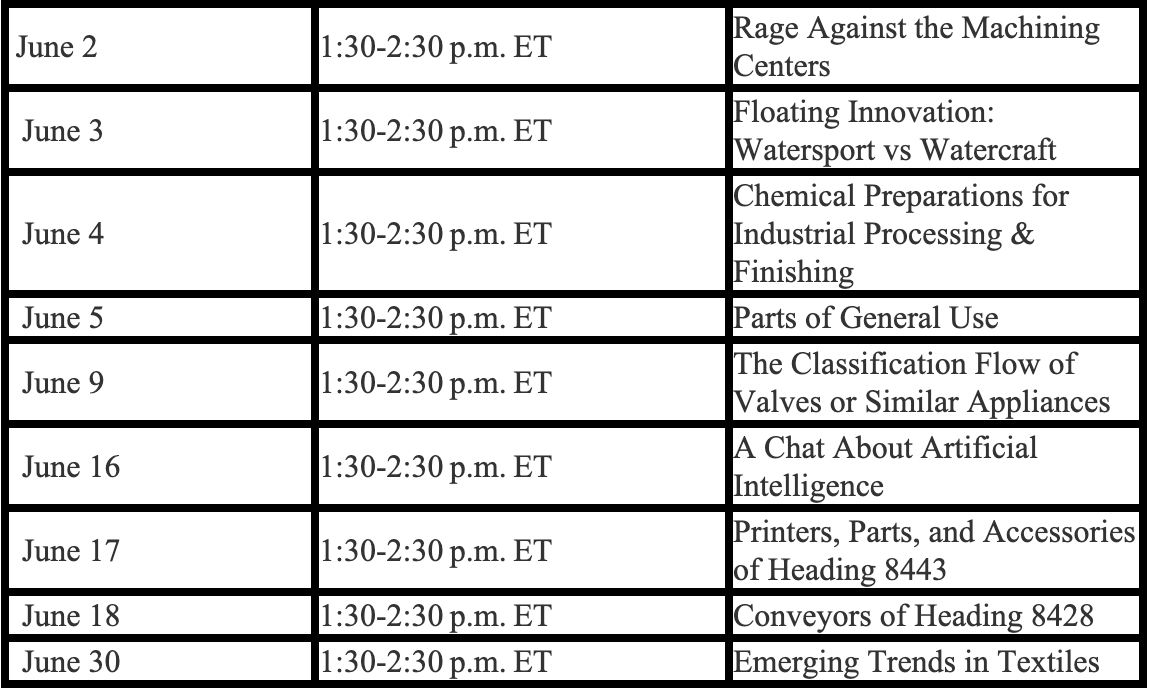
The June schedule is as follows:
NCSD’s July Webinar Schedule:
Wednesday, July 1, 2026 at 1:30 p.m. ET: Festivus for the Rest of Us! Festive Article Classification– The “Festivus for the Rest of Us! Festive Article Classification” is part of the 2026 Educations Commodity Specific Webinar Series hosted by the National Commodity Specialist Division, Regulations and Rulings, Office of Trade. This webinar highlights recent updates to Chapter 95 festive article classification and clarifies common classification questions.
Thursday, July 2, 2026 at 1:30 p.m. ET: Stepping Forward in Smart Kicks – The “Stepping Forward in Smart Kicks” is part of the 2026 Educations Commodity Specific Webinar Series hosted by the National Commodity Specialist Division, Regulations and Rulings, Office of Trade. This webinar will explain the classification of smart footwear.
Tuesday, July 7, 2026 at 1:30 p.m. ET: Plates, Sheets, Film, Foil & Strip of Plastics– The “Plates, Sheets, Film, Foil & Strip of Plastics” is part of the 2026 Educations Commodity Specific Webinar Series hosted by the National Commodity Specialist Division, Regulations and Rulings, Office of Trade. This webinar will focus on the nuances of classification of plates, sheets, film, foil, and strip of plastics in headings 3920 and 3921 of the Harmonized Tariff Schedule of the United States. It will examine the applicable legal notes and Explanatory Notes.
Wednesday, July 8, 2026 at 1:30 p.m. ET: Reinforced, Laminated or Both? Safety Headgear of 6506– The “Reinforced, Laminated or Both? Safety Headgear of 6506” is part of the 2026 Educations Commodity Specific Webinar Series hosted by the National Commodity Specialist Division, Regulations and Rulings, Office of Trade. The webinar will examine the tariff classification of safety headgear under heading 6506, HTSUS, with a focus on distinguishing between reinforced plastics, laminated plastics and products incorporating both. The presentation will also explore how advancements in material engineering, smart protective equipment, and emerging manufacturing technologies are shaping the future of trade and creating new classification challenges for next generation safety headgear.
Tuesday, July 14, 2026 at 1:30 p.m. ET: Anode Active Materials – An Overview – The “Anode Active Materials - An Overview” is part of the 2026 Educations Commodity Specific Webinar Series hosted by the National Commodity Specialist Division, Regulations and Rulings, Office of Trade. This webinar will discuss materials that are used to coat the anodes of lithium-ion batteries and discuss some recent trade related developments concerning them.
Thursday, July 16, 2026 at 1:30 p.m. ET: Beverage Drinking Vessels Confusion: Let’s Classify It!– The “Beverage Drinking Vessels Confusion: Let’s Classify it!” is part of the 2026 Educations Commodity Specific Webinar Series hosted by the National Commodity Specialist Division, Regulations and Rulings, Office of Trade. This webinar will focus on the correct classification of various drinking vessels that are classified in Harmonized Tariff Schedule of the United States headings 3924, 6912, 7323, 7615, and 9617.
Friday, July 17, 2026 at 1:30 p.m. ET: Display Devices are Getting “Smarter!” – The “Display Devices are Getting “Smarter!”” is part of the 2026 Educations Commodity Specific Webinar Series hosted by the National Commodity Specialist Division, Regulations and Rulings, Office of Trade. This webinar will provide an overview of the future of trade and how it impacts the tariff classification of innovative and emerging technology in flat panel display modules, wearable displays, monitors, and televisions, including how AI is transforming the future of displays. It will also provide the key difference between displays classified in headings 8524 vs. 8528, HTSUS, and case studies of the latest display technologies classified in these headings.
Tuesday, July 21, 2026 at 1:30 p.m. ET: You’ve Got to Pick a Pocket or Two – The “You’ve Got to Pick a Pocket or Two” is part of the 2026 Educations Commodity Specific Webinar Series hosted by the National Commodity Specialist Division, Regulations and Rulings, Office of Trade. The webinar will cover: CBP’s definition of a pocket; a discussion of what is, and is not, a pocket; the location/placement of pockets on garments; and how these considerations can affect the proper classification of apparel.
Reference:
Webinar External Schedule May Final 2026.pdf
CSMS # 68770785 - National Commodity Specialist Division (NCSD) June 2026 Webinars
CSMS # 68856484 - National Commodity Specialist Division (NCSD) July 2026 Webinars
The New Rules of U.S. Importing: Navigating the June 3 Executive Order on Customs Enforcement
On June 3, the White House issued the Executive Order on “Strengthening Customs Enforcement.” This directive initiates the most aggressive overhaul of U.S. import regulations in years. With tight implementation deadlines ranging from 45 to 180 days, the rules for importing into the U.S. have fundamentally changed.
This new directive significantly restricts foreign entities, eliminates penalty mitigation for repeat errors, and ties corporate compliance directly to your ability to secure customs bonds.
Join us alongside a Alan Klestadt Partner GDLSK and Mike Brown President/CEO from Avalon Risk Management for an essential live briefing. We will translate this executive order into immediate, actionable steps for your business.
Webinar Details:
- Date: June 30, 2026
- Time: 2:00 PM EST
- Duration: 60 Minutes
Reference:
Get expert advice on customs and foreign trade, direct from our comprehensive customs brokerage and trade services teams.