
06/05/2026
U.S. Trade Representative Proposes Sweeping Tariffs on 60 Economies Over Forced Labor Concerns
Check out this week's Customs Corner to read about U.S. Trade Representative Proposes Sweeping Tariffs on 60 Economies Over Forced Labor Concerns, President Trump Adjusts Tariffs on Aluminum, Steel, and Copper Imports, and more.
Trade and Customs Updates
U.S. Trade Representative Proposes Sweeping Tariffs on 60 Economies Over Forced Labor Concerns
The Office of the U.S. Trade Representative (USTR) announced today a series of determinations and proposed actions targeting 60 global economies for failing to prohibit and enforce bans on the importation of goods produced with forced labor. This move follows investigations and the advice of advisory committees, culminating in a detailed report under Sections 301(b) and 304(a) of the Trade Act.
The USTR determined that the acts, policies, and practices of all 60 economies under review are "unreasonable and burden or restrict U.S. commerce," rendering them actionable under U.S. trade law. The report singled out 54 countries—including China, India, Brazil, Russia, and the United Kingdom—for failing to impose and enforce prohibitions on importing forced labor goods. Six additional economies—Canada, Ecuador, the European Union, Indonesia, Mexico, and Pakistan—were cited for failing to effectively enforce such bans.
Economic and Ethical Rationale
The USTR’s findings emphasize that the lack of robust import prohibitions:
- Undermines global efforts to eliminate forced labor,
- Distorts market conditions by enabling lower-cost production using forced labor,
- Harms the profitability of ethical firms, and
- Facilitates the circumvention of existing U.S. forced labor import bans.
These failures, the USTR argues, subject U.S. producers to unfair competition and displace ethically produced goods in both the U.S. and global markets.
Proposed Actions
To address these concerns, the USTR proposes:
- Ad valorem duties on all products from the 60 economies under investigation, except for certain exemptions (detailed in Annex A of the Federal Register) such as goods subject to Section 232 tariffs, critical raw materials, informational materials, donations, accompanied baggage, and items where tariffs would have minimal impact on forced labor practices.
- Additional duties of 10% for economies that have imposed forced labor import prohibitions (Canada, Ecuador, EU, Indonesia, Mexico, Pakistan) or made commitments under Reciprocal Trade Agreements (including Argentina, Bangladesh, Cambodia, Malaysia, and Taiwan), or have partial regimes (the United Kingdom).
- Additional duties of 12.5% for all other economies that have failed to impose and enforce forced labor import prohibitions.
A special textile mechanism is also proposed, allowing a certain volume of apparel and textile imports to enter the U.S. at a reduced tariff rate, calibrated to the volume of U.S. textile exports or U.S. cotton products imported by these trading partners.
Next Steps
The USTR’s proposals are now open for public comment and further review. In accordance with section 304(b) of the Trade Act (19 U.S.C. 2414(b)), USTR invites comments from interested persons with respect to the proposed actions to be taken in the investigations. To be assured of consideration, you must submit written comments 14 on the proposed actions by July 6, 2026.
The Section 301 Committee will hold public hearings starting on July 7, 2026, at 10:00 a.m. in the main hearing room of the U.S. International Trade Commission, located at 500 E Street SW, Washington, DC 20436. The hearings may continue as needed.
Information on submitting comments and attending the hearing can be found in the Federal Register.
Reference:
FRN - Section 301 Forced Labor Import Ban Actionabilty and Proposed Action 6-2-26 FINAL.pdf
USTR Report Sec 301 FL 301 6-2-26 FINAL for upload.pdf
President Trump Adjusts Tariffs on Aluminum, Steel, and Copper Imports
President Trump has issued a new proclamation that further adjusts the 232 tariffs on certain aluminum, steel, and copper products. The decision comes after the Secretary of Commerce alerted the President that recent changes in the global market are impacting key U.S. industries that depend on these metals, including agricultural equipment, construction machinery, and industrial tools.
Effective June 8, 2026: The tariff schedules and lists of affected products will be updated.
Most aluminum and steel products will face a 25% tariff, unless a special rule applies.
Special Rules for Certain Countries and Products:
For products from Argentina, Ecuador, El Salvador, Guatemala, Japan, South Korea, Liechtenstein, Switzerland, Taiwan, the United Kingdom, and the European Union:
- If the normal rate of duty is less than 15%, the sum of the normal rate plus 232 will be a total of 15%.
- If the normal rate of duty is 15% or more, there is no extra Section 232 duty.
Products made entirely of U.S.-sourced aluminum or steel will have a lower tariff of 10%.
Canada and Mexico (under USMCA trade agreement):
- The 25% tariff only applies to the non-U.S. portion of the product. However, the total tariff can’t be less than 15%.
- U.S. Customs will issue guidance on how to determine U.S. content. Importers caught cheating could face penalties.
The updated tariffs will apply until December 31, 2027. Starting January 1, 2028, different rates may apply according to previous proclamations.
What Counts as “U.S.-Made”? For a product to qualify as being made entirely in the U.S., at least 85% of its aluminum, steel, or copper content must come from and be processed in the United States.
Reference:
Controversy Over Duty Refunds Heats Up at CIT; Customs Commissioner Ordered to Testify in Person
A significant dispute has emerged at the U.S. Court of International Trade (CIT) concerning the refund of duties on liquidated entries, where importers have neither filed suit nor protested. U.S. Customs and Border Protection (CBP) maintains that it lacks authority to refund duties on finally liquidated entries unless the importer has initiated legal action. Judge Richard Eaton, however, disagrees with this position and has ordered CBP Commissioner Rodney Scott to appear in person at a hearing scheduled for June 9, 2026.
CBP responded by requesting the court amend its order to permit testimony from other senior officials, including Executive Assistant Commissioner for Trade Susan Thomas or Brandon Lord, who have previously submitted declarations regarding the refund process. CBP argued that these officials possess more direct knowledge of the relevant processes and that judicial precedent does not support compelling high-ranking executives to testify in court. The court denied this request.
CBP has indicated its intention to seek relief from the U.S. Court of Appeals for the Federal Circuit. The administration also announced plans to appeal the CIT’s injunction requiring the return of all duties paid under the International Emergency Economic Powers Act (IEEPA), contending that such an order exceeds the court’s authority.
In a May 29, 2026, filing, the Department of Justice (DOJ) stated that entries more than 90 days past liquidation cannot be refunded unless a judge orders importer-by-importer reliquidations, which the court has thus far declined to do. The DOJ asserts that the CIT does not possess the authority to mandate refunds on finally liquidated entries for importers who have not brought suit.
Despite these legal challenges, CBP reported it is currently in the process of refunding approximately $85 billion out of $166 billion collected under IEEPA, with additional refund requests continuing to be filed. The agency noted that it is implementing programmatic enhancements to process the vast majority of flagged entries for reconciliation.
Judge Eaton, in his recent order, emphasized that all unlawfully collected IEEPA duties should be refunded to the importers who made deposits. He acknowledged CBP’s development of the CAPE refund program and its expeditious rollout but noted that billions of dollars remain unprocessed, with the majority of refunds thus far benefitting large importers over smaller ones.
Judge Eaton stated that Commissioner Scott’s testimony is necessary to clarify whether the government intends to refund all IEEPA duties, as required when collections are deemed unlawful. The DOJ, in response, has signaled plans to appeal the order for Commissioner Scott’s appearance.
Reference:
USTR Launches Section 301 Investigation Into Brazil’s Trade Practices, Proposes 25% Tariff
The Office of the U.S. Trade Representative (USTR) announced late last night the launch of a new Section 301 investigation targeting Brazil, citing a range of unfair trade practices that are said to harm U.S. commercial interests. As a proposed remedy, the USTR is considering imposing a 25% tariff on certain Brazilian imports, with exemptions for raw materials critical to the U.S. supply chain and products already covered by Section 232 tariffs; however, footwear and leather goods are notably excluded from these exemptions.
A public hearing regarding the investigation is set for July 6, 2026. U.S. Trade Representative Jamieson Greer stated, “I launched this Section 301 investigation at President Trump’s direction to address longstanding and pervasive U.S. concerns with certain of Brazil’s trade policies and practices... However, we continue to have substantial differences in resolving the issues identified in this investigation. I look forward to continuing engagement with the Brazilian Government in advance of the July 15, 2026 statutory deadline for taking responsive action.”
The investigation will examine six key areas of concern:
Digital Trade and Electronic Payments: U.S. social media companies face secret content takedown orders, financial penalties, asset restrictions, and competitive disadvantages in electronic payment services.
Unfair Preferential Tariffs: Brazil provides preferential tariff treatment to goods from Mexico and India, disadvantaging U.S. products.
Anti-Corruption Enforcement: Brazil is criticized for insufficient action against bribery and corruption.
Intellectual Property Protection: Weak enforcement against counterfeiting and piracy, slow patent processing, and inconsistent anti-piracy efforts are highlighted.
Ethanol Market Access: Brazil has failed to reciprocate tariff treatment for U.S. ethanol exports.
Illegal Deforestation: Despite existing laws, Brazil has not effectively enforced measures to curb illegal deforestation.
Stakeholders are encouraged to review the Federal Register notice for details and participate in the upcoming hearing. The investigation could lead to significant new tariffs and heightened trade tensions between the U.S. and Brazil if issues are not resolved by the mid-July deadline.
Reference:
U.S. Launches Investigation into Vietnam’s Intellectual Property Practices
On May 29, 2026, U.S. Trade Representative Jamieson Greer began a formal investigation into Vietnam’s handling of intellectual property (IP) rights under Section 301 of the Trade Act of 1974. The investigation aims to find out if Vietnam’s failure to address long-standing problems with IP protection and enforcement is unfair, discriminatory, or harmful to American businesses. U.S. officials will closely review Vietnam’s laws and practices regarding IP and analyze how they affect American commerce. After the investigation, Ambassador Greer, in consultation with President Trump, will decide what actions, if any, the U.S. should take in response.
May 29, 2026: USTR will open the docket for submission of written comments on May 20, 2026. To be assured of consideration, submit written comments by July 2, 2026.
Reference:
U.S. Customs and Border Protection Announces Registration Open for June Trade Enforcement Webinars
U.S. Customs and Border Protection (CBP) is pleased to announce that registration is now open for its free quarterly webinars in June 2026. These essential sessions are designed to empower the public with the knowledge to effectively report suspected trade violations and file Enforce and Protect Act (EAPA) allegations with CBP.
Upcoming June Webinar Dates (Registration Now Open):
Please click on the direct links below to register for individual webinars:
- Trade Violations Reporting (TVR) Webinar - Tuesday, June 23, 2026, at 1:30 p.m. EST
- Enforce and Protect Act (EAPA) Webinar - Thursday, June 25, 2026, at 1:00 p.m. EST
Rescheduled August Webinar Dates:
Please note that due to the recent government shutdown, the March and April webinars have been rescheduled. We encourage you to plan for these new dates:
- Rescheduled Trade Violations Reporting (TVR) Webinar: Monday, August 10, 2026, at 1:00 p.m. EST
- Rescheduled Enforce and Protect Act (EAPA) Webinar: Wednesday, August 12, 2026, at 1:00 p.m. EST
Registration links for the August rescheduled webinars will become available one month prior to each webinar date at https://go.dhs.gov/4i4.
Registration is free and open to everyone, but you must register to attend.
Reference:
National Commodity Specialist Division (NCSD) June and July 2026 Webinars
The National Commodity Specialist Division, part of the Office of Trade, is launching a new series of over 30 commodity-specific educational webinars aimed at supporting both internal and external stakeholders. This year’s program, themed "The Future of Trade: Innovation and Emerging Technology," will focus on the impact of rapidly advancing technology while also offering general classification guidance to facilitate legitimate trade.
The webinars will run from May through September 2026, beginning at 1:30 p.m. ET and lasting approximately one hour, except for sessions on September 22, 24, and 25, which will start at 11:00 a.m. ET. Registration is currently open for the June webinars, with monthly registration for subsequent sessions through September.
The webinars will be hosted on the WebEx platform to ensure a seamless experience, and recordings will be posted publicly at Trade Outreach Webinars | U.S. Customs and Border Protection
Upcoming webinar links and further details are available on the CBP website Trade Outreach Webinars | U.S. Customs and Border Protection
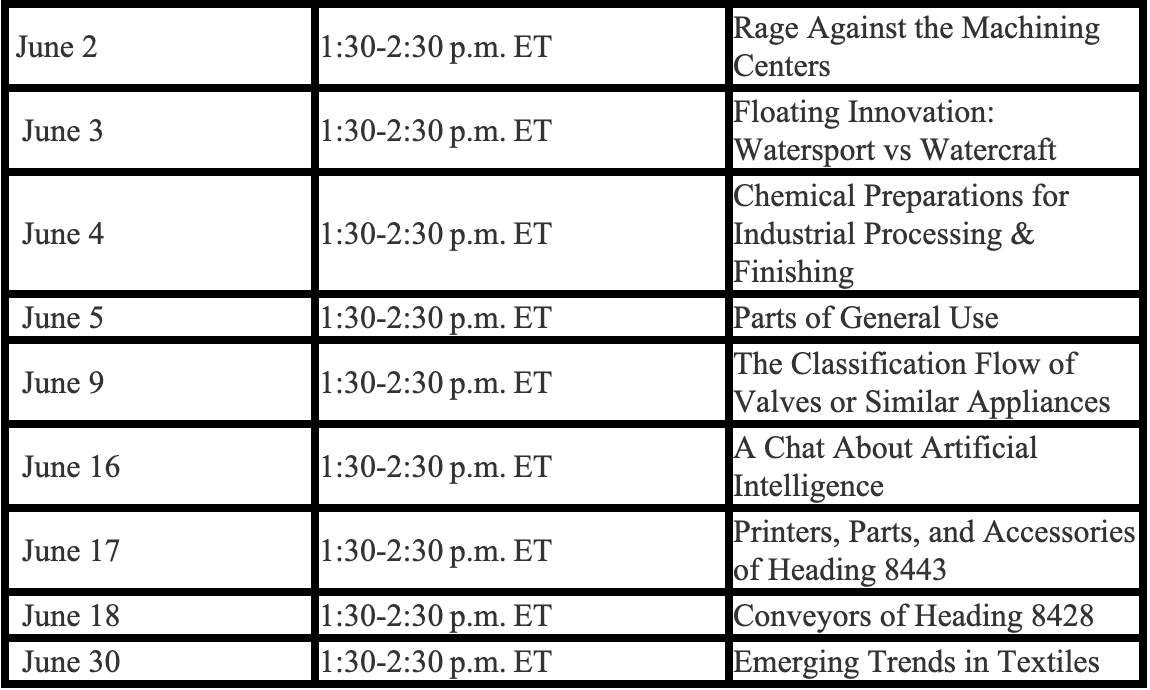
The June schedule is as follows:
NCSD’s July Webinar Schedule:
Wednesday, July 1, 2026 at 1:30 p.m. ET: Festivus for the Rest of Us! Festive Article Classification – The “Festivus for the Rest of Us! Festive Article Classification” is part of the 2026 Educations Commodity Specific Webinar Series hosted by the National Commodity Specialist Division, Regulations and Rulings, Office of Trade. This webinar highlights recent updates to Chapter 95 festive article classification and clarifies common classification questions.
Thursday, July 2, 2026 at 1:30 p.m. ET: Stepping Forward in Smart Kicks – The “Stepping Forward in Smart Kicks” is part of the 2026 Educations Commodity Specific Webinar Series hosted by the National Commodity Specialist Division, Regulations and Rulings, Office of Trade. This webinar will explain the classification of smart footwear.
Tuesday, July 7, 2026 at 1:30 p.m. ET: Plates, Sheets, Film, Foil & Strip of Plastics – The “Plates, Sheets, Film, Foil & Strip of Plastics” is part of the 2026 Educations Commodity Specific Webinar Series hosted by the National Commodity Specialist Division, Regulations and Rulings, Office of Trade. This webinar will focus on the nuances of classification of plates, sheets, film, foil, and strip of plastics in headings 3920 and 3921 of the Harmonized Tariff Schedule of the United States. It will examine the applicable legal notes and Explanatory Notes.
Wednesday, July 8, 2026 at 1:30 p.m. ET: Reinforced, Laminated or Both? Safety Headgear of 6506 – The “Reinforced, Laminated or Both? Safety Headgear of 6506” is part of the 2026 Educations Commodity Specific Webinar Series hosted by the National Commodity Specialist Division, Regulations and Rulings, Office of Trade. The webinar will examine the tariff classification of safety headgear under heading 6506, HTSUS, with a focus on distinguishing between reinforced plastics, laminated plastics and products incorporating both. The presentation will also explore how advancements in material engineering, smart protective equipment, and emerging manufacturing technologies are shaping the future of trade and creating new classification challenges for next generation safety headgear.
Tuesday, July 14, 2026 at 1:30 p.m. ET: Anode Active Materials – An Overview – The “Anode Active Materials - An Overview” is part of the 2026 Educations Commodity Specific Webinar Series hosted by the National Commodity Specialist Division, Regulations and Rulings, Office of Trade. This webinar will discuss materials that are used to coat the anodes of lithium-ion batteries and discuss some recent trade related developments concerning them.
Thursday, July 16, 2026 at 1:30 p.m. ET: Beverage Drinking Vessels Confusion: Let’s Classify It! – The “Beverage Drinking Vessels Confusion: Let’s Classify it!” is part of the 2026 Educations Commodity Specific Webinar Series hosted by the National Commodity Specialist Division, Regulations and Rulings, Office of Trade. This webinar will focus on the correct classification of various drinking vessels that are classified in Harmonized Tariff Schedule of the United States headings 3924, 6912, 7323, 7615, and 9617.
Friday, July 17, 2026 at 1:30 p.m. ET: Display Devices are Getting “Smarter!” – The “Display Devices are Getting “Smarter!”” is part of the 2026 Educations Commodity Specific Webinar Series hosted by the National Commodity Specialist Division, Regulations and Rulings, Office of Trade. This webinar will provide an overview of the future of trade and how it impacts the tariff classification of innovative and emerging technology in flat panel display modules, wearable displays, monitors, and televisions, including how AI is transforming the future of displays. It will also provide the key difference between displays classified in headings 8524 vs. 8528, HTSUS, and case studies of the latest display technologies classified in these headings.
Tuesday, July 21, 2026 at 1:30 p.m. ET: You’ve Got to Pick a Pocket or Two – The “You’ve Got to Pick a Pocket or Two” is part of the 2026 Educations Commodity Specific Webinar Series hosted by the National Commodity Specialist Division, Regulations and Rulings, Office of Trade. The webinar will cover: CBP’s definition of a pocket; a discussion of what is, and is not, a pocket; the location/placement of pockets on garments; and how these considerations can affect the proper classification of apparel.
Reference:
Webinar External Schedule May Final 2026.pdf
CSMS # 68770785 - National Commodity Specialist Division (NCSD) June 2026 Webinars
Get expert advice on customs and foreign trade, direct from our comprehensive customs brokerage and trade services teams.