
USTR Finds Manufacturing Practices in 14 Economies Actionable Under Section 301
U.S. Trade Representative Jamieson Greer has determined that manufacturing-related policies and practices in 14 economies contribute to structural excess capacity, burden or restrict U.S. commerce, and are actionable under Section 301(b) of the Trade Act of 1974.
The determinations cover Bangladesh, Cambodia, China, the European Union, India, Indonesia, Japan, Korea, Malaysia, Singapore, Switzerland, Taiwan, Thailand, and Vietnam. The USTR also published economy-specific reports supporting its findings. No determinations have been made regarding Mexico or Norway at this time.
Greer said trading partners have pursued industrial strategies involving targeted support for manufacturing, wage and labor suppression, financial assistance, non-market inputs, and other practices that distort competition and weaken the U.S. manufacturing base.
He argued that international recognition of the risks posed by structural excess capacity has not translated into meaningful change, despite discussions at the G7, G20, World Trade Organization, and other forums.
“President Trump is proposing to take action to bring about the elimination of these unfair acts, policies, and practices,” Greer said. “In doing so, we can level the playing field for American workers and chart a new, more sustainable course for the world economy.”
USTR will hold public hearings on proposed actions in the investigations beginning January 25, 2027, with additional sessions as needed.
Interested parties must submit written comments by January 5, 2027. Requests to appear at the hearings, accompanied by a summary of testimony, must also be submitted by that date to be assured of consideration.
Based on the text provided, below are proposed rates. These are proposed rates, not final or effective tariffs, and certain goods would be exempt.
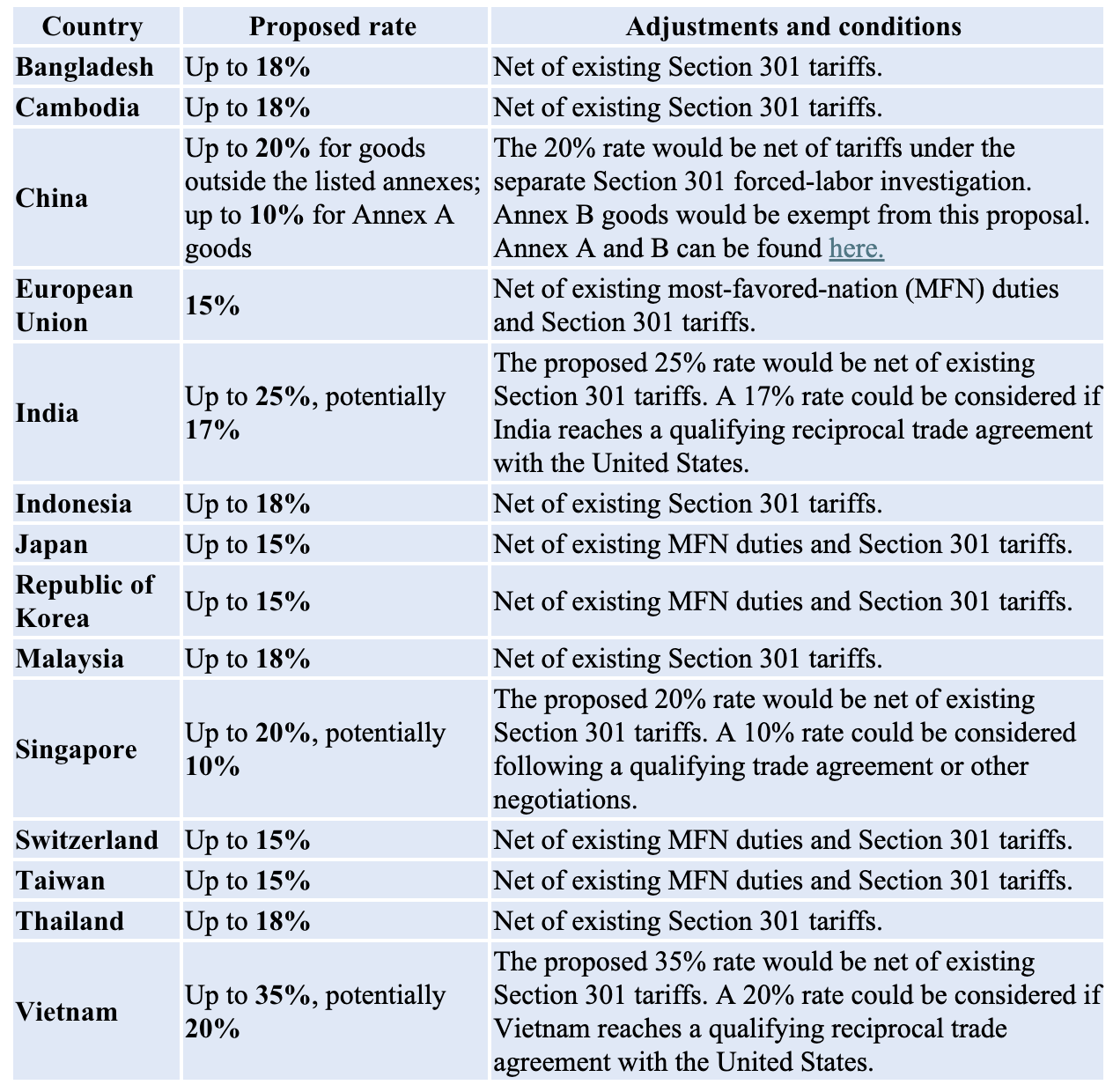
Important: “Net of” means the specified existing duties would be credited when calculating the new tariff—not that the full proposed percentage would automatically be added on top. For example, if the intended rate is 18% and a product already carries a 10% Section 301 tariff, the additional tariff would be 8%.
These figures are not necessarily the total import duty: other duties, Section 232 treatment, product exemptions, and the final terms could affect what applies to a particular shipment.
Reference:
USTR Proposes Higher Sugar Duties and 10% Tariff on Brazilian Aircraft
The USTR is proposing changes to its Section 301 tariff action involving Brazil, including additional duties on certain sugar imports from all countries and a 10% tariff on finished aircraft imported from Brazil.
The proposed measures aim to increase pressure on Brazil to address practices USTR has deemed actionable in its investigation. Those practices concern digital trade and electronic payment services, preferential tariffs, anti-corruption enforcement, intellectual property protection, ethanol market access, and illegal deforestation.
Sugar Duties Would Apply Across All Origins
USTR proposes replacing the existing 25% tariff on certain Brazilian raw and refined sugar products with additional per-kilogram duties on sugar entering the United States at the high-tier, or out-of-quota, duty rate.
The additional duties would apply on a nondiscriminatory basis, regardless of the sugar’s country of origin:
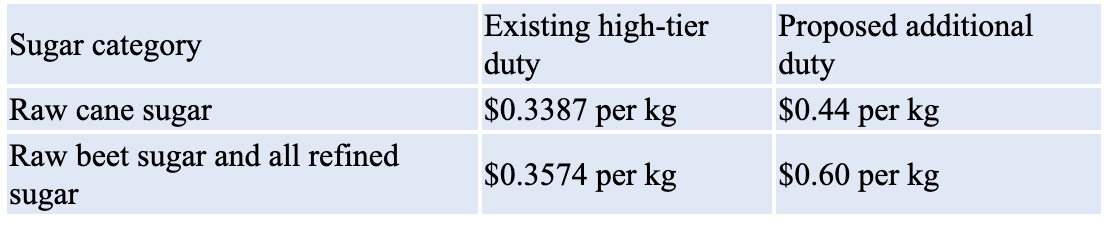
USTR said applying the additional duties across all origins would help prevent trade diversion that could weaken the measure’s effectiveness. Because sugar is a globally traded, interchangeable commodity, other suppliers could otherwise increase shipments to the United States while Brazil redirects exports to their markets.
Brazilian Aircraft Would Lose Exemption
The proposal would also end the exemption for finished Brazilian aircraft established in the July 20, 2026, notice and impose a 10% Section 301 tariff on those imports.
USTR cited Brazil’s position as the leading exporter of regional aircraft to the United States and one of the world’s largest commercial jet manufacturers as reasons the measure could provide additional negotiating leverage.
Public Comments and Hearing
The changes remain proposals, and USTR is seeking public input before proceeding.
- November 27, 2026: Public comment period opens.
- December 7, 2026: Deadline to submit hearing participation requests and testimony summaries to be assured of consideration.
- December 30, 2026: Written comments due.
- January 14, 2027: Public hearing begins at 10 a.m. in Conference Rooms 1 and 2 at 1724 F Street NW, Washington, DC. The hearing may continue on January 15, 2027, if necessary.
Reference: