
Keepeek
Customs-Corner----IEEPA-Duties

11/13/2026

CBP Reports $128.4 Billion in IEEPA CAPE Refunds Sent to Treasury

Check out this week's Customs Corner to read about CBP Reports $128.4 Billion in IEEPA CAPE Refunds Sent to Treasury, U.S. Extends 178 China Tariff Exclusions Through January 9, 2027, and more!

Trade and Customs Updates

CBP Reports $128.4 Billion in IEEPA CAPE Refunds Sent to Treasury

CBP has reported that approximately $128.4 billion in refunds, including duties and interest, have been completed through its certified CAPE Refund component and sent to the U.S. Department of the Treasury for disbursement. 


Brandon Lord, Executive Director of the Trade Programs Directorate within CBP’s Office of Trade, provided the update on IEEPA CAPE declarations on November 10, 2026. All figures reflect processing status as of noon Eastern Time on November 5, 2026. 


CBP reported that 321,021 CAPE declarations had been submitted, of which 226,899 passed file validations. The declarations that cleared file validations covered 44 million entries, while 6.9 million entries included in submitted declarations failed entry-level validations. 


Approximately $138.3 billion in potential and certified refunds had been accepted for processing in CAPE. Of that amount, approximately $128.4 billion had been completed through the agency-certified refund component and forwarded to Treasury. Transmission to Treasury is a step toward disbursement and does not, by itself, confirm that recipients have received payment. 


A further 18,072 refunds, totaling approximately $737 million, had not been transmitted to Treasury because the importer of record or its authorized CBP Form 4811 designee had not provided Automated Clearing House (ACH) account information. 


For CAPE Phase 3, CBP reported that 4,579 declarations, covering 16,011,353 entries, passed both file- and entry-level validations and been accepted for processing. 


CBP continues to grant Phase 3 access on a rolling basis to plaintiffs who filed a case with the CIT and have submitted a valid importer of record (IOR) number. Plaintiffs who submitted a valid IOR number on or before August 27, 2026, are currently eligible to file Phase 3 CAPE declarations. 


Those who submitted a valid IOR number after that date will receive access later. CBP will continue to notify plaintiffs through emails to their counsel when they become eligible to file. 


Reference: 

gov.uscourts.cit.19175.69.0.pdf

U.S. Extends 178 China Tariff Exclusions Through January 9, 2027

The USTR has extended all 178 remaining product exclusions from additional Section 301 duties on Chinese goods, citing ongoing discussions with China. 


The extension takes effect on November 10, 2026, and continues through 11:59 p.m. Eastern Time on January 9, 2027. It maintains tariff relief for eligible products covered by the exclusions rather than removing the broader Section 301 tariffs. 


The exclusions relate to the Section 301 investigation into China’s acts, policies and practices concerning technology transfer, intellectual property and innovation. Although most exclusions have expired in previous years, 178 remain in force. 


The extension covers exclusions under Harmonized Tariff Schedule of the United States headings 9903.88.69 and 9903.88.70, along with their associated U.S. notes. 


It applies to eligible goods entered for consumption, or withdrawn from a warehouse for consumption, during the specified extension period. Both tariff headings are being amended to replace the previous November 9, 2026, expiration date with January 9, 2027. 


USTR said its decision reflects ongoing discussions with China and takes into account public comments submitted in response to the September 16, 2025 Federal Register notice, as well as earlier comments. 


The agency also considered advice from advisory committees and the interagency Section 301 Committee. 


Reference: 

Federal Register :: Notice of Product Exclusion Extensions: China's Acts, Policies, and Practices Related to Technology Transfer, Intellectual Property, and Innovation  

U.S. Extends Suspension of Maritime Fees and Related Duties Until January 10, 2027 

The USTR has extended the suspension of maritime transport fees and certain related duties for two months, until January 10, 2027, to allow further discussions with China over the acts, policies and practices under investigation. 


The extension took effect on November 9, 2026. At the President’s direction, the Trade Representative determined that the circumstances supporting the initial suspension remain in place and that continuing to suspend the measures is appropriate. 


The decision covers responsive actions initially taken in April 2025 and subsequently modified in October and November 2025. It also updates five headings in the Harmonized Tariff Schedule of the United States, replacing the previous November 10, 2026, deadline with January 10, 2027. 


During the suspension period, no party will accrue liability for, or be required to pay, the maritime transport service fees established under Annexes I, II and III of the April 23, 2025, Federal Register notice, as subsequently modified. 


The suspension also applies to the duties specified in Annex V.A of the October 16, 2025, notice, as modified by the November 13, 2025 notice. 


USTR will continue monitoring the issues raised in the investigation under Section 301 of the Trade Act. Before the January 10, 2027, deadline, it will assess whether to extend the suspension again or take further action. 


Any additional modification may take account of comments previously submitted in response to proposed measures. Section 307 of the Trade Act authorizes the Trade Representative to modify Section 301 actions, subject to the President’s direction, including when an action is no longer appropriate. 


Reference: 

Federal Register :: Notice of Modification of Section 301 Action: China's Targeting of the Maritime, Logistics, and Shipbuilding Sectors for Dominance 

U.S. Extends Vietnam Intellectual Property Investigation by Three Months

The USTR has extended its ongoing Section 301 investigation into Vietnam’s intellectual property protection and enforcement practices by three months, citing complex issues that require additional time. 


The extension took effect on November 3, 2026, at 12:01 a.m. EDT. USTR will now determine whether the practices under investigation warrant action—and what action, if any, to take—by February 28, 2027. 


The investigation began on May 29, 2026, under Section 302(b)(2) of the Trade Act of 1974. It examines certain acts, policies and practices of the Government of Vietnam related to intellectual property rights. 


For investigations initiated under that provision that do not involve a trade agreement, the law generally requires USTR to issue its findings within six months. However, it allows the timeframe to extend to nine months under specified circumstances, including when an investigation involves complex or complicated issues. 


USTR cited that complexity provision as the basis for the extension. The notice does not announce findings or trade measures against Vietnam. 


Reference: 

Federal Register :: Notice of Determination To Extend Section 301 Investigation of Vietnam's Acts, Policies, and Practices Related to Intellectual Property Protection and Enforcement 

CBP Opens Testing for Polysilicon Duties Ahead of December 4 Implementation

CBP is activating four simulated Chapter 99 tariff classifications on November 12, 2026, to help importers prepare for new duties on certain polysilicon and polysilicon derivative products effective December 4, 2026. 


The duties were established by Presidential Proclamation 11052, issued on August 6, 2026, and published at 91 FR 51975. The proclamation provides for minimum import prices on covered products. 


The four classifications are unofficial and available exclusively for testing in the Automated Commercial Environment (ACE) certification environment. They are not intended for use in live customs entries. 


Classifications Available for Testing 
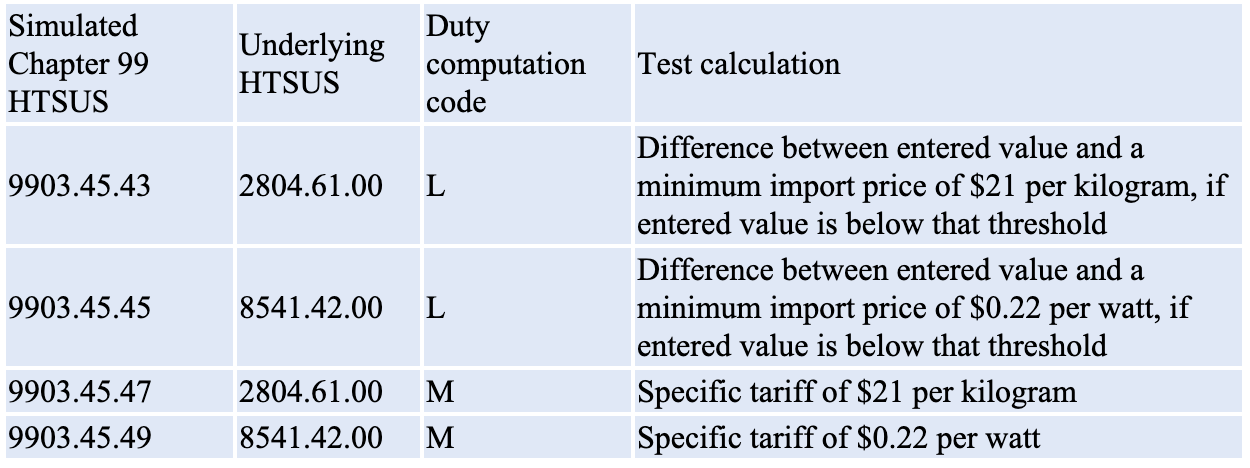
 

For Duty Computation Code L, filers must first divide the entered value by the applicable quantity to determine the per-unit value. 

If the per-unit value is below the applicable minimum import price, the duty is calculated by multiplying the minimum import price by the quantity and then subtracting the entered value. If the per-unit value meets or exceeds the minimum import price, filers should report zero duty under the simulated classification. 


For Duty Computation Code M, the specific tariff is calculated by multiplying the applicable rate—$21 per kilogram or $0.22 per watt—by the corresponding import quantity. 


CBP is also updating Appendix F: Duty Calculation of the CBP and Trade Automated Interface Requirements (CATAIR) to include Duty Computation Codes L and M. The update will be posted in the Draft Chapters: Future Capabilities section on CBP.gov. 


CBP recommends that the trade community submit test entries in the ACE certification environment before December 4, 2026, to confirm that their systems can calculate and transmit the new duties correctly. 


Reference: 

CSMS # 70422566 - Section 232 Duties on Imports of Polysilicon and Polysilicon Derivatives in the Certification (CERT) Testing Environment 

Get expert advice on customs and foreign trade, direct from our comprehensive customs brokerage and trade services teams.