
07/10/2026
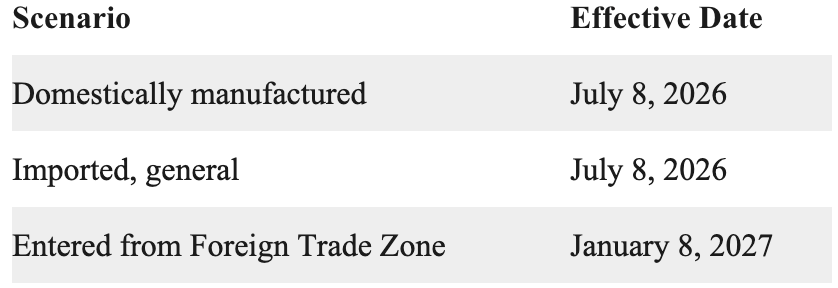
CPSC eFiling Effective as of July 8, 2026
Check out this week's Customs Corner to read about CPSC eFiling Effective as of July 8, 2026, CBP Updates CAPE Declaration Policy for Warehouse Entries Effective July 7 and more!
Trade and Customs Updates
CPSC eFiling Effective as of July 8, 2026
The U.S. Consumer Product Safety Commission (CPSC) has officially launched its eFiling program, requiring importers of regulated consumer products to submit compliance certificates electronically before products enter U.S. commerce.
CPSC states the eFiling program allows them to focus enforcement resources on areas of greatest need, strengthening efforts to keep unsafe products out of the U.S. marketplace and facilitating legitimate trade. The program also enhances collaboration between CPSC and U.S. Customs and Border Protection, reinforcing a coordinated government approach to consumer safety at the border.
CPSC Acting Chairman Peter A. Feldman highlighted the importance of the program, noting its role in combating challenges posed by a surge of imported consumer goods, especially direct-to-consumer shipments that bypass traditional retail channels. Feldman emphasized that eFiling does not impose new compliance burdens; instead, it updates the process for transmitting already-required information from importers to CPSC. Domestic manufacturers, including small businesses, are not affected by this requirement.
The eFiling program follows more than a decade of development and industry testing, including pilot phases from 2016 to 2024 and a voluntary adoption period. Requirements for consumer products imported into Foreign Trade Zones and later entered for consumption or warehousing will become effective January 8, 2027.
References:
CBP Updates CAPE Declaration Policy for Warehouse Entries Effective July 7
CBP has announced that, effective July 7, warehouse entries (Entry Types 21 and 22) are no longer accepted on CAPE Declarations. Any warehouse entries submitted with a CAPE Declaration will now be rejected, displaying the “ENTRY TYPE NOT ALLOWED” error message.
Warehouse withdrawals (Entry Types 31, 32, 34, and 38), however, will continue to be accepted on CAPE Declarations, as IEEPA duties are paid at the time of withdrawal. CBP will process approved IEEPA duty refunds on warehouse withdrawals submitted via CAPE Declarations after the associated warehouse entry is (re)liquidated. The standard CBP liquidation process for warehouse entries remains unchanged and will occur after all withdrawals are completed, at which point refunds for IEEPA duties may be processed.
CBP clarified that any warehouse entries (Entry Types 21 or 22) accepted on a CAPE Declaration between April 20 and July 6, without corresponding warehouse withdrawals, will not be (re)liquidated with a refund of IEEPA duties. In these cases, filers must submit new CAPE Declarations with the relevant warehouse withdrawals where IEEPA duties were paid.
Additional questions can be directed to CBP’s Office of Trade Relations at [email protected].
Reference:
Modifications to Post Summary Correction (PSC) Procedures
CBP published a Federal Register announcing modifications to the processing of post-summary corrections (PSCs) and the payment of increases in estimated duties, taxes, and fees resulting from a PSC. The modifications announced will become operational and participants must comply with the modifications as of August 5, 2026.
Key Details:
- All payments must be transmitted electronically when there is an increase in estimated duties, taxes, and fees resulting from a PSC via Automated Clearinghouse (ACH) starting on August 5, 2026, and will no longer be able to pay such increases via check or cash. To make electronic payments, importers and brokers must first enroll in either the ACH Debit process or ACH Credit process. To pay via ACH Debit or ACH Credit, test participants must follow the regular payment process implemented by CBP for ACH payments found at https://www.cbp.gov/trade/basic-import-export/automated-clearinghouse-ach.
- Importers and brokers may choose to pay the full amount of the increase in estimated duties, taxes, and fees resulting from a PSC prior to liquidation or wait to be billed at liquidation before making a payment. A test participant may not submit a subsequent PSC until the increase in duties, taxes, and fees resulting from a previously filed PSC is paid in full and processed by CBP. In other words, if only a partial payment of increased estimated duties, taxes, and fees resulting from a PSC is made, a test participant will not be able to submit a subsequent PSC.
- The notice modifies the timeframe for filing PSCs in the case of suspended liquidations. This modification allows importers and brokers to submit a PSC outside of the regular 300-day timeframe for filing a PSC for entries where liquidation of those entries is suspended beyond 300 days after the date of entry, and the entries have an associated suspension basis (such as Countervailing Duty (CVD) Suspend, Antidumping Duty (ADD) Suspend, AD/CVD Suspend, Subject to Enforce and Protect Act (EAPA), or Subject to Court Injunction) at the time of PSC filing. CBP will post the allowable suspension bases on CBP.gov.
- Interest payment on the increased estimated duties, taxes, and fees resulting from a PSC will not be accepted prior to liquidation. Importers and brokers must pay any interest owed to CBP as a result of the PSC once CBP liquidates the entry and issues a bill, if necessary. This clarification is intended to ensure proper application of payments to open bills and improve enforcement of PSCs by CBP.
Further information as to entry types and data elements that can and cannot be filed via PSC, as well as criteria and rules for filing a PSC can be found in the Federal Register.
Reference:
CBP Provides Progress in CAPE Declarations and Refund Processing
Brandon Lord, Executive Director of Trade at U.S. Customs and Border Protection (CBP), provided an update on the progress of the CAPE (Customs Automated Processing Environment) program. As of 3 p.m. Eastern Time on June 29, 2026, a total of 213,939 CAPE declarations had been submitted, with 149,840 successfully passing file validations. The primary reasons for failed validations included mismatches between importer of record or filer information, incorrect entry numbers, and improperly formatted .CSV files.
The validated declarations encompassed 18.1 million entries with IEEPA duties that cleared further entry-specific checks and were accepted for duty removal through CAPE. Of these, 15.92 million entries have already been liquidated or reliquidated without IEEPA duties. Conversely, 4.36 million entries failed entry-level validations due to issues such as lapsed re-liquidation authority, missing Chapter 99 HTS codes, or prior submission on a different CAPE declaration.
CBP reported that approximately $104.29 billion in potential and certified refunds have been accepted for processing, with $71.06 billion in refunds (including duties and interest) already completed, certified, and sent to the U.S. Department of Treasury for disbursement. Treasury updates confirm that these refunds are being regularly paid out. The agency continues to review and finalize outstanding potential refunds through CAPE’s Review and Liquidation/Reliquidation component. Notably, 8,384 refunds remain unprocessed due to missing Automated Clearing House (ACH) account information from importers or their authorized CBP Form 4811 designees.
On June 29, 2026, at 5 a.m. Eastern Time, CBP launched new CAPE functionality in the ACE system, allowing importers and brokers to include on a CAPE Declaration any unliquidated entries (or those liquidated within the last 80 days) flagged for reconciliation but without a filed Reconciliation Entry (Entry Type 09). By 5 p.m. on June 30, 2026, 1.6 million such entries had been successfully filed and are now being processed.
CBP Suspends De Minimis Exemption for International Mail, Announces New Postal Informal Entry Process
U.S. Customs and Border Protection (CBP) has indefinitely suspended the de minimis administrative exemption under 19 U.S.C. § 1321(a)(2)(C) for imports valued at $800 or less arriving through the international postal network. The announcement, published in the Federal Register on June 24, 2026, follows last year’s Executive Order 14324, which suspended the exemption for products from all countries as of July 30, 2025, and moved international mail shipments to an interim entry process.
Effective July 24, 2026, merchandise entering the United States via international mail will no longer qualify for the de minimis exemption. Instead, such shipments must be processed under a new postal informal entry procedure outlined in CBP regulations and detailed in the Federal Register. This updated process generally applies to goods imported by mail valued at $2,500 or less that are eligible for informal entry.
The new guidance clarifies the steps for importing goods by mail under this system, including who is eligible to use the process, the required information for entry, bond and payment procedures, and submission deadlines. The change aims to enhance CBP’s oversight of international mail imports and ensure compliance with U.S. trade regulations.
Importers and mailers are advised to review the new regulations and prepare for the transition to the postal informal entry process before the July 24 effective date. For further information, consult the Federal Register notice or CBP’s official guidance.
References:
CSMS # 69183472 - Updated Global Guidance for International Mail
President Trump Delays Tariffs on Commercial Aircraft and Parts, Orders Negotiations with Trade Partners
President Trump announced yesterday that no immediate tariffs will be imposed on imports of commercial aircraft, jet engines, and related parts under Section 232, citing ongoing national security considerations and the need for further negotiations.
In a proclamation issued on July 9, the President directed the U.S. Department of Commerce and the Office of the U.S. Trade Representative (USTR) to begin or continue negotiations with international trading partners. The goal is to address concerns over the potential impairment of U.S. national security linked to such imports. The agencies must provide the President with updates on their progress within 180 days.
The proclamation emphasized that, given the current circumstances and future requirements, pursuing negotiations is the most appropriate course of action to safeguard national security interests. However, the President left open the possibility of considering alternative measures, including tariffs or other remedies, depending on the outcome of these negotiations.
Reference:
NCBFAA Launches Online Tools to Support Customs Brokers’ Continuing Education Compliance
The National Customs Brokers and Forwarders Association of America (NCBFAA) has introduced two new online resources to assist licensed customs brokers in meeting the U.S. Customs and Border Protection (CBP) continuing education requirement, which is now in effect for the current compliance cycle.
For the first time, customs brokers must earn 20 continuing education credits by January 31, 2027, and certify completion in a triennial status report to CBP by February 28, 2027, including payment of a CBP-set fee. CBP developed and oversees this mandatory education program, while NCBFAA, through its Educational Institute (NEI), provides support to help brokers meet the requirement.
The resources outline CBP’s requirements and allow members to track earned credits and discover qualifying educational activities.
Reference:
U.S. Customs and Border Protection Announces Registration Open for Trade Enforcement Webinars
U.S. Customs and Border Protection (CBP) is pleased to announce that registration is now open for its free quarterly webinars. These essential sessions are designed to empower the public with the knowledge to effectively report suspected trade violations and file Enforce and Protect Act (EAPA) allegations with CBP.
Rescheduled August Webinar Dates:
Please note that due to the recent government shutdown, the March and April webinars have been rescheduled. We encourage you to plan for these new dates:
- Rescheduled Trade Violations Reporting (TVR) Webinar: Monday, August 10, 2026, at 1:00 p.m. EST
- Rescheduled Enforce and Protect Act (EAPA) Webinar: Wednesday, August 12, 2026, at 1:00 p.m. EST
Registration links for the August rescheduled webinars will become available one month prior to each webinar date at https://go.dhs.gov/4i4.
Registration is free and open to everyone, but you must register to attend.
Reference:
National Commodity Specialist Division (NCSD) July 2026 Webinars
The National Commodity Specialist Division, part of the Office of Trade, is launching a new series of over 30 commodity-specific educational webinars aimed at supporting both internal and external stakeholders. This year’s program, themed "The Future of Trade: Innovation and Emerging Technology," will focus on the impact of rapidly advancing technology while also offering general classification guidance to facilitate legitimate trade.
The webinars will run from May through September 2026, beginning at 1:30 p.m. ET and lasting approximately one hour, except for sessions on September 22, 24, and 25, which will start at 11:00 a.m. ET. Registration is currently open for the June webinars, with monthly registration for subsequent sessions through September.
The webinars will be hosted on the WebEx platform to ensure a seamless experience, and recordings will be posted publicly at Trade Outreach Webinars | U.S. Customs and Border Protection
Upcoming webinar links and further details are available on the CBP website Trade Outreach Webinars | U.S. Customs and Border Protection
NCSD’s July Webinar Schedule:
Wednesday, July 1, 2026 at 1:30 p.m. ET: Festivus for the Rest of Us! Festive Article Classification – The “Festivus for the Rest of Us! Festive Article Classification” is part of the 2026 Educations Commodity Specific Webinar Series hosted by the National Commodity Specialist Division, Regulations and Rulings, Office of Trade. This webinar highlights recent updates to Chapter 95 festive article classification and clarifies common classification questions.
Thursday, July 2, 2026 at 1:30 p.m. ET: Stepping Forward in Smart Kicks – The “Stepping Forward in Smart Kicks” is part of the 2026 Educations Commodity Specific Webinar Series hosted by the National Commodity Specialist Division, Regulations and Rulings, Office of Trade. This webinar will explain the classification of smart footwear.
Tuesday, July 7, 2026 at 1:30 p.m. ET: Plates, Sheets, Film, Foil & Strip of Plastics – The “Plates, Sheets, Film, Foil & Strip of Plastics” is part of the 2026 Educations Commodity Specific Webinar Series hosted by the National Commodity Specialist Division, Regulations and Rulings, Office of Trade. This webinar will focus on the nuances of classification of plates, sheets, film, foil, and strip of plastics in headings 3920 and 3921 of the Harmonized Tariff Schedule of the United States. It will examine the applicable legal notes and Explanatory Notes.
Wednesday, July 8, 2026 at 1:30 p.m. ET: Reinforced, Laminated or Both? Safety Headgear of 6506 – The “Reinforced, Laminated or Both? Safety Headgear of 6506” is part of the 2026 Educations Commodity Specific Webinar Series hosted by the National Commodity Specialist Division, Regulations and Rulings, Office of Trade. The webinar will examine the tariff classification of safety headgear under heading 6506, HTSUS, with a focus on distinguishing between reinforced plastics, laminated plastics and products incorporating both. The presentation will also explore how advancements in material engineering, smart protective equipment, and emerging manufacturing technologies are shaping the future of trade and creating new classification challenges for next generation safety headgear.
Tuesday, July 14, 2026 at 1:30 p.m. ET: Anode Active Materials – An Overview – The “Anode Active Materials - An Overview” is part of the 2026 Educations Commodity Specific Webinar Series hosted by the National Commodity Specialist Division, Regulations and Rulings, Office of Trade. This webinar will discuss materials that are used to coat the anodes of lithium-ion batteries and discuss some recent trade related developments concerning them.
Thursday, July 16, 2026 at 1:30 p.m. ET: Beverage Drinking Vessels Confusion: Let’s Classify It! – The “Beverage Drinking Vessels Confusion: Let’s Classify it!” is part of the 2026 Educations Commodity Specific Webinar Series hosted by the National Commodity Specialist Division, Regulations and Rulings, Office of Trade. This webinar will focus on the correct classification of various drinking vessels that are classified in Harmonized Tariff Schedule of the United States headings 3924, 6912, 7323, 7615, and 9617.
Friday, July 17, 2026 at 1:30 p.m. ET: Display Devices are Getting “Smarter!” – The “Display Devices are Getting “Smarter!”” is part of the 2026 Educations Commodity Specific Webinar Series hosted by the National Commodity Specialist Division, Regulations and Rulings, Office of Trade. This webinar will provide an overview of the future of trade and how it impacts the tariff classification of innovative and emerging technology in flat panel display modules, wearable displays, monitors, and televisions, including how AI is transforming the future of displays. It will also provide the key difference between displays classified in headings 8524 vs. 8528, HTSUS, and case studies of the latest display technologies classified in these headings.
Tuesday, July 21, 2026 at 1:30 p.m. ET: You’ve Got to Pick a Pocket or Two – The “You’ve Got to Pick a Pocket or Two” is part of the 2026 Educations Commodity Specific Webinar Series hosted by the National Commodity Specialist Division, Regulations and Rulings, Office of Trade. The webinar will cover: CBP’s definition of a pocket; a discussion of what is, and is not, a pocket; the location/placement of pockets on garments; and how these considerations can affect the proper classification of apparel.
Reference:
CSMS # 68856484 - National Commodity Specialist Division (NCSD) July 2026 Webinars
Get expert advice on customs and foreign trade, direct from our comprehensive customs brokerage and trade services teams.