
09/04/2026
New Copper Smelt and Cast Country Reporting Requirements Starting September 14, 2026
Check out this week's Customs Corner to read about New Copper Smelt and Cast Country Reporting Requirements Starting September 14, 2026, and more!
Trade and Customs Updates
New Copper Smelt and Cast Country Reporting Requirements Starting September 14, 2026
Beginning Monday, September 14, 2026, ACE will reject entry summaries for certain copper imports if the primary country of smelt and country of cast are not properly reported. When the required "54 record type 12" data for copper is missing, ACE will issue the F794 error message—now considered a fatal error—requiring immediate correction.
The new mandate applies to imports of specified copper articles from all countries except the United States, covering HTSUS classifications 8544.42.10, 8544.42.20, 8544.42.90, and 8544.49.10. In addition to the primary country of smelt and country of cast, importers may also provide the secondary country of smelt. If any of these details are unknown, "OTH" (other) may be entered as a placeholder.
For the full list of requirements, importers should refer to CSMS 69252300.
Reference:
CSMS # 69711865 - Copper Additional Smelt and Cast Country Detail Error Code Update
CBP Proposes New Rules to Boost Supply Chain Transparency for U.S. Imports
U.S. Customs and Border Protection is considering regulatory changes aimed at increasing its oversight of supply chains for goods imported into the United States. The proposed amendments would require more detailed reporting on the parties involved in import transactions, adoption of advanced technical solutions for supply chain tracing, and the collection of foreign export documentation submitted to foreign customs authorities prior to shipment to the U.S.
These measures are intended to strengthen CBP’s ability to detect and prevent illicit or illegally transshipped imports that circumvent U.S. customs and trade laws. CBP is inviting public comments on these proposals, which can be submitted via the Federal eRulemaking Portal at http://www.regulations.gov by referencing docket number USCBP-2026-1058.
Instructions and more information can be found in the Federal Register. Comments must be received on or before December 1, 2026.
Reference:
Federal Register :: Heightened Import Disclosures for Supply Chain Visibility
U.S. Announces New Tariffs on Unmanned Aircraft Systems and Components, Effective September 3, 2026
On August 13, 2026, President Trump issued Proclamation 11055, introducing significant new tariffs ranging from 10% to 100% on certain imports of Unmanned Aircraft Systems (UAS) and their components. These additional duties will apply to goods classified under specified Harmonized Tariff Schedule of the United States (HTSUS) codes in Chapters 85 and 88.
The first wave of tariffs—between 10% and 100%—takes effect on September 3, 2026. Importers of affected UAS products and parts must now report the appropriate Chapter 99 HTSUS classification for their shipments. The duties will apply to goods entered for consumption or withdrawn from warehouses for consumption from 12:01 a.m. Eastern Time on September 3, 2026.
A second phase of tariffs is scheduled for February 9, 2027, when an additional 25% duty will be imposed on other UAS components.
The applicable provisional tariffs for both phases as well as additional guidance are outlined in the CSMS.
Reference:
USITC Updates HTSUS Reporting Categories and Section 301 Exclusions Effective July 1, 2026
Effective July 1, 2026, the U.S. International Trade Commission (USITC) has updated certain ten-digit statistical reporting categories within the Harmonized Tariff Schedule of the United States (HTSUS), as part of its obligations under section 484(f) of the Tariff Act of 1930. These changes impact four product exclusions related to the Section 301 investigation concerning China’s policies on technology transfer, intellectual property, and innovation, as detailed in previous Federal Register notices (89 FR 46948, 90 FR 23987, 90 FR 42500, and 90 FR 55232).
Specifically, for goods entered for consumption or withdrawn from warehouse on or after 12:01 a.m. EST on July 1, 2026, notes 20(vvv)(i)(4), 20(vvv)(i)(5), and 20(vvv)(i)(6) to subchapter III of chapter 99 are revised to add the language: “through June 30, 2026; described in statistical reporting numbers 8413.91.9039, 8413.91.9046, 8413.91.9059 or 8413.91.9099 effective July 1, 2026,” following the phrase “January 1, 2020.” Additionally, note 20(vvv)(iv)(4) is amended by inserting “prior to July 1, 2026; described in statistical reporting numbers 3926.90.9915 or 3926.90.9920 effective July 1, 2026” after “3926.90.9910.”
These modifications ensure that the affected product exclusions remain properly classified under the updated HTSUS codes.
Reference:
House Passes Government Funding Bill, Extends AGOA and Haiti Preference Programs
On September 1, 2026, the U.S. House of Representatives approved a bill to keep the federal government funded through December 11, 2026. In addition to securing short-term government funding, the legislation includes a two-year extension of the African Growth and Opportunity Act (AGOA) and the Haiti HELP/HOPE trade preference programs, extending their expiration dates to December 31, 2028. The bill now awaits President Trump’s signature to become law.
Reference:
CBP Announces Enhanced IOR Enforcement Under Executive Order 14411
U.S. Customs and Border Protection has announced, via a notice in the Federal Register, that it will begin enhanced enforcement of Importer of Record (IOR) data requirements starting September 18, 2026, in accordance with Executive Order 14411 issued on June 3, 2026. This initiative centers on validating the accuracy of information provided in CBP Form 5106, the Importer Identity Form. If CBP identifies inaccurate data—such as an incorrect physical address, email, or phone number—on Form 5106, the associated IOR number will be voided.
CBP’s review will ensure that the physical address listed is the actual location of the IOR and not a P.O. Box, registered agent, broker, or forwarder. The email address and phone number must also belong directly to the IOR, with brokers prohibited from substituting their own contact information. Notably, the address does not have to be within the United States; foreign addresses are permitted as indicated in Form 5106, Section 2A.
Additionally, Executive Order 14411 mandates that foreign IORs cannot rely on a continuous bond unless they can demonstrate that U.S. revenue is fully protected and all compliance requirements are met. The primary focus of this enforcement effort is on foreign importers who lack a substantial presence in the United States.
Reference:
Strengthening Customs Enforcement – The White House
Federal Register :: Accuracy of Importer of Record Data Submitted to CBP
Combating Unfair Trade Webinar
This webinar is designed to help the trade community understand new antidumping and countervailing duty (AD/CVD) orders and empower the public with the knowledge to effectively report suspected AD/CVD violations and file Enforce and Protect Act allegations with CBP.
Webinar Details:
- Topic: Combating Unfair Trade
- Date: Monday, September 21, 2026
- Time: 2:00 PM EST
Registration: Registration is complimentary and open to the public; however, advance registration is required to attend. Please click here to register.
Reference:
NCSD Launches New Webinar Series on Innovation and Emerging Technology in Trade
The National Commodity Specialist Division (NCSD), part of the Office of Trade, has announced the next round of approximately 30 educational webinars aimed at supporting both internal and external stakeholders. This year’s series, themed “The Future of Trade: Innovation and Emerging Technology,” will spotlight rapidly evolving technological trends while continuing to offer essential classification guidance to promote legitimate trade.
Scheduled from May through September 2026, most webinars will begin at 1:30 p.m. Eastern Time and run for about an hour, with exceptions on September 22, 24, and 25, which will start at 11:00 a.m. ET. Registration is now open for the September sessions.
Interested participants can register at Trade Outreach Webinars | U.S. Customs and Border Protection
The September schedule is below:
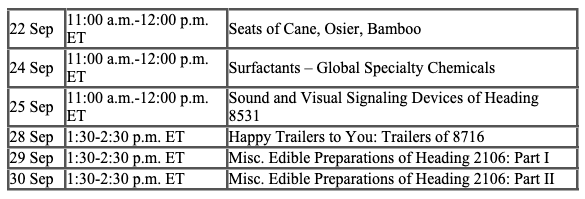
Reference:
CSMS # 69733635 - National Commodity Specialist Division (NCSD) September 2026 Webinars
Customs Trade Partnership Against Terrorism (CTPAT) 101 and Small Business Initiative
U.S. Customs and Border Protection’s (CBP) Office of Field Operations is hosting an informative CTPAT 101 webinar as part of the Small Business Initiative. This session is designed to introduce small businesses to the CTPAT program and explain how it supports supply chain security and trusted trade. Participants will receive a beginner-friendly overview of CTPAT, including the program’s purpose, potential benefits, eligibility considerations, and basic steps for getting started. The webinar will also highlight resources available to small businesses.
Who Should Attend:
Small business owners, importers, exporters, customs brokers, logistics providers, manufacturers, and other trade community members interested in learning more about CTPAT.
Webinar topic:
Customs Trade Partnership Against Terrorism (CTPAT) 101 and Small Business Initiative
Date and time:
Thursday, September 3, 2026, 11:00 AM | (UTC-04:00) Eastern Time (US & Canada)
Register link:
https://cbp.webex.com/weblink/register/r74115c18ec135e1e41f475b688870775
Get expert advice on customs and foreign trade, direct from our comprehensive customs brokerage and trade services teams.