Keepeek
Customs-Corner-IEEPA-Tariff

10/30/2026

U.S. Customs Announces Major Changes to 50% Tariff on Certain Canadian Imports

Check out this week's Customs Corner to read about U.S. Customs Announces Major Changes to 50% Tariff on Certain Canadian Imports, CBP Reports Progress on IEEPA CAPE Refund Processing, and more!

Trade and Customs Updates

U.S. Customs Announces Major Changes to 50% Tariff on Certain Canadian Imports 

CBP has announced significant changes to the list of Canadian-origin products subject to additional duties under Section 338. 

The changes implement a Presidential Proclamation issued October 23, 2026, and take effect at 12:01 a.m. Eastern Time on October 30, 2026. 


Under the updated requirements: 


● 22 HTSUS classifications are removed from the list of products subject to the additional 50% duty. 

● 100 additional HTSUS classifications are added and become subject to the additional 50% duty. 


This update creates potential duty increases or decreases for companies importing products from Canada. Merchandise previously excluded from the additional tariff may now become subject to the 50% duty, while certain products previously covered will no longer be subject to this additional duty. 


The changes specifically affect the classifications covered under HTSUS 9903.03.14. The requirements associated with HTSUS 9903.03.12 and 9903.03.13 remain unchanged. 


As of October 30, 2026, products of Canada classifiable in the following HTSUS classifications corresponding to HTSUS 9903.03.14 are no longer subject to the 50% ad valorem duties imposed under Section 338: 
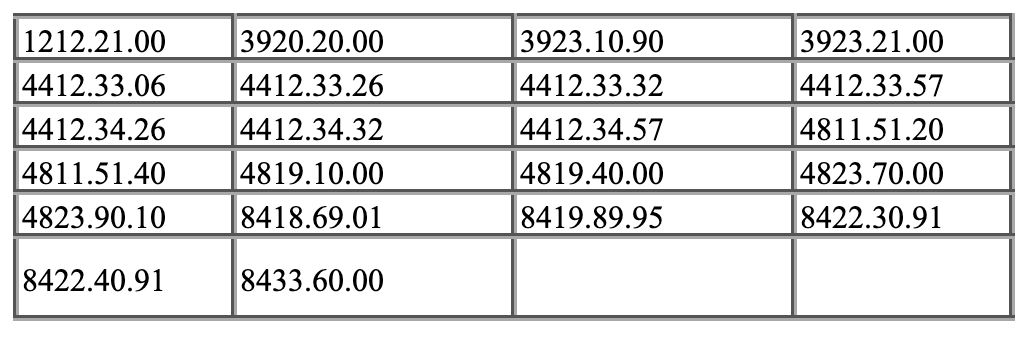
 

Also, as of October 30, 2026, 100 additional HTSUS classifications will be subject to HTSUS 9903.03.14.  These HTS can be found here.  


Reference: 

CSMS # 70314289 - Further Modifying Section 338 Additional Duties on Certain Goods of Canada 


Section 338 Canada Modified HTS LIST 10.25.2026.pdf 

CBP Reports Progress on IEEPA CAPE Refund Processing

U.S. Customs and Border Protection (CBP) has accepted approximately $137.9 billion in potential and certified refunds for processing through CAPE, with approximately $127.7 billion certified and sent to the U.S. Treasury for disbursement. 


Brandon Lord, Executive Director of the Trade Programs Directorate within CBP’s Office of Trade, provided the update on October 26, 2026. The figures reflect processing activity as of 3 p.m. Eastern Time on October 23, 2026. 


CBP reported receiving 315,069 CAPE declarations, of which 222,754 passed file validation, covering 44 million entries. 

The most common reasons for file validation failures were: 


  • Mismatches involving the importer of record or filer. 
  • Incorrect or nonexistent entry numbers. 
  • CSV files that did not match the template published in the ACE portal. 


Of the entries covered by declarations that passed file validation, 36.32 million had been liquidated or reliquidated without IEEPA duties. A further 6.7 million entries failed entry-level validation, primarily because they fell outside CBP’s 90-day reliquidation authority, lacked a Chapter 99 Harmonized Tariff Schedule number used to assess IEEPA duties, or had already appeared on a previous CAPE declaration. 


Approximately $127.7 billion in refunds, including duties and interest, had been completed through the CAPE Refund component, certified by CBP and transmitted to Treasury. Updates received by CBP’s financial accounting system indicate that Treasury is regularly disbursing these certified refunds. 


However, 19,797 refunds worth approximately $990 million had not been transmitted to Treasury because the importer of record or its authorized CBP Form 4811 designee had not provided ACE ACH account information. 


CBP also reported that 3,960 CAPE declarations had been accepted for Phase 3 processing, covering 15,834,190 entries, after passing both file- and entry-level validation.


Access to Phase 3 is being granted on a rolling basis to plaintiffs who have submitted a valid importer of record number. Those who provided a valid number before August 14, 2026, are currently eligible to file Phase 3 declarations. 


CBP will continue notifying plaintiffs through emails to their legal counsel as access becomes available. 


Reference: 

gov.uscourts.cit.19175.65.0.pdf 

Court Reviews CAPE Refund Progress and Clarifies Phase 3 Eligibility

The Court of International Trade (CIT) reviewed progress on the CAPE program at a closed conference on October 27, 2026, and ordered the government to submit a further update by November 10. 


The discussion followed an October 26 declaration filed by Brandon Lord, Executive Director of the Trade Programs Directorate within CBP’s Office of Trade, outlining progress on refunds of IEEPA duties. 


CBP launched CAPE Phase 3 on October 6, 2026, covering finally liquidated entries filed by plaintiffs for which the court has ordered reliquidation, including entries subject to protest. 


The court stated its understanding that plaintiffs in individual cases can process eligible IEEPA refund claims through Phase 3 without withdrawing their protests, regardless of whether those protests concern only IEEPA duties or also raise other issues. 


Participants also discussed error codes preventing CAPE processing. Guidance on dedicated CBP mailboxes for IEEPA questions, along with updated frequently asked questions, is available on CBP’s IEEPA refund page. 


The court ordered the government to file a short CAPE progress report by 5:00 p.m. Eastern Time on Tuesday, November 10, 2026. 

A further closed settlement conference is scheduled for Thursday, November 12, 2026, at 2:00 p.m. Eastern Time, with participation in person and via Webex. 


Reference: 

gov.uscourts.cit.19175.66.0.pdf 

Potential Port Security Strike Could Affect Eight Los Angeles and Long Beach Terminals

Terminal security personnel could begin a strike on Sunday, November 1, potentially disrupting operations at eight container terminals across the ports of Los Angeles and Long Beach. 


The International Longshore and Warehouse Union (ILWU) Local 26, which represents terminal security personnel at the two ports, has threatened strike action as negotiations continue. No work stoppage has been confirmed. 


If picket lines are established, other ILWU workers may decline to cross them, potentially affecting vessel handling, yard activities and truck gate operations at the terminals involved. 


ILWU Local 26 represents approximately 250 security personnel who oversee terminal access, cargo security and other operational functions at facilities throughout the Los Angeles and Long Beach port complex. 


The union’s previous labour agreement expired in July 2025. Employees have since continued working under contract extensions while negotiations proceed with employers represented by the Pacific Maritime Association (PMA). 


The latest extension is scheduled to expire on Sunday, 1 November 2026, with strike action authorized to begin at 17:00 Pacific Time. 


Negotiations remain ongoing with support from federal mediation, but the parties have not yet reached an agreement. 

DHS Adds Three Chinese Biotechnology Companies to UFLPA Entity List 

DHS has added three Shenzhen-based biotechnology companies to the Uyghur Forced Labor Prevention Act (UFLPA) Entity List, citing their roles in genetic testing linked to Xinjiang government initiatives. 


The companies are BGI Genomics Co., Ltd., MGI Tech Co., Ltd., and Shenzhen BGI Technology Co., Ltd., also known as BGI Group or BGI Holdings. 


All three companies were added under Section 2(d)(2)(B)(ii), which covers entities working with the Xinjiang government to recruit, transport, transfer, harbor, or receive forced labor or members of persecuted groups out of the region. 


According to the government’s findings, BGI Genomics and BGI Group conducted genetic testing alongside Xinjiang authorities, while MGI supplied genetic testing capacity. U.S. officials stated that they had reasonable cause to believe these activities facilitated labor transfers involving Uyghurs, Kazakhs, Kyrgyz, or other persecuted groups. 


The Forced Labor Enforcement Task Force (FLETF) determined that each company met the criteria for inclusion under this provision. 


BGI Genomics and BGI Group were also added under Section 2(d)(2)(B)(v), which addresses entities sourcing materials from Xinjiang or through specified government labor schemes involving forced labor. 


The government cited BGI Genomics’ testing of genetic material from plants, animals, and bacterial diseases sourced from Xinjiang. For BGI Group, it cited testing of human genetic material sourced from the region, alongside plans to test plant and animal genetic materials. 


The update therefore covers three distinct companies, with BGI Genomics and BGI Group listed under both statutory categories. 


Reference: 

Federal Register :: Notice Regarding the Uyghur Forced Labor Prevention Act Entity List 

USTR Proposes Two-Month Extension of China-Related Maritime Fee Suspension 

The USTR has proposed extending the suspension of certain maritime transport fees and duties through January 9, 2027, to allow further negotiations with China. 


The proposed extension would run from 12:00 a.m. Eastern Time on November 10, 2026, through 11:59 p.m. Eastern Time on January 9, 2027. The United States continues to engage with China with the aim of eliminating the acts, policies and practices under review in the investigation. 


During the proposed suspension period, no party would accrue liability for, or be required to pay: 


  • Maritime transport service fees under Annexes I, II and III of the April 23, 2025, notice, as modified by the October 16, 2025, notice. 
  • Duties specified in Annex V.A of October 16, 2025, notice. 


The extension remains a proposal, and USTR is seeking public comments from interested parties before proceeding with the modification. 


The comment period opened on October 23, 2026, at 9:00 a.m. Eastern Time. Written comments must be submitted by October 30, 2026, at 5:00 p.m. Eastern Time to be assured of consideration. 


Reference: 

2026-21755.pdf 

CBP Streamlines ACH Refund Access in ACE Portal 

CBP announced updates scheduled for October 29, 2026, to simplify access to ACH refund information in the ACE Secure Data Portal. 


The changes affect the portal’s Importer sub-account, reorganizing financial transaction navigation, and eliminating the need to manually refresh ACH refund data. 


The existing “ACH Refund Authorization” tab will become a sub-tab under a new “Financial Transactions” header, bringing current and future financial transaction sub-tabs together in one location. 


The ACH Refund Authorization sub-tab will retain its existing functionality, allowing trade users to manage ACH refund information directly within their ACE Portal accounts. 


CBP will also remove the “Get Info/Refresh” button, which users previously had to select to retrieve current ACH refund data held by the agency. 


Under the announced changes, the portal will automatically retrieve the current ACH refund data available in the system, removing that manual step. 


Reference: 

CSMS # 70297853 - ACE Portal Update: New Financial Transactions Tab Coming Soon 

Get expert advice on customs and foreign trade, direct from our comprehensive customs brokerage and trade services teams.